
Prelude: The Takeaways from Parts 1 and 2
I’ve written about pencil grip, letter formation instruction, and handwriting over the past two months. Read Part 1 here, and Part 2 here. The main takeaways:
- The development of pencil grip and handwriting begins very soon after birth. This involves developing eye-hand coordination, hand strength, pincer grasp, upper body posture. I offer many strategies for families and pre-school educators in Part 1.
- A developmental sequence exists. Therefore, it is important to avoid ‘forcing’ pre-writing and writing skill instruction. A child’s motor skill development may still be immature.
- Several pencil grips exist which are considered ‘functional’ (traditional tri-pod, quadruped, modified tri-pod or “artist’s grip”).
- Writing letters (optimally with a ‘functional pencil grip’) significantly aids literacy development when taught in conjunction with letter identification, sound/symbol association, and work with sound blending (decoding, AKA ‘reading’) and sound segmentation (encoding, AKA ‘spelling’).
- A ‘functional pencil grip’ optimizes both legibility and serviceability. Legibility refers to the ability of one–including the writer–to read or reread what has been written. Serviceability refers to the ease with which the writer is able to produce written output.
- It is never too late to teach a student to correct a non-functional pencil grip. This is true particularly if the student experiences illegibility and/or non-serviceability. This includes: slow writing speed, excess fatigue, writing avoidance, and even refusal to write by hand. I outline various strategies and tools to help remediate non-functional pencil grips in Part 2. My additional disclaimer: Not every student with a poor pencil grip experiences difficulty writing by hand or attaining literacy. And not every student possessing a functional pencil grip will attain literacy easily. That said, it doesn’t hurt to try to foster a functional pencil grip.
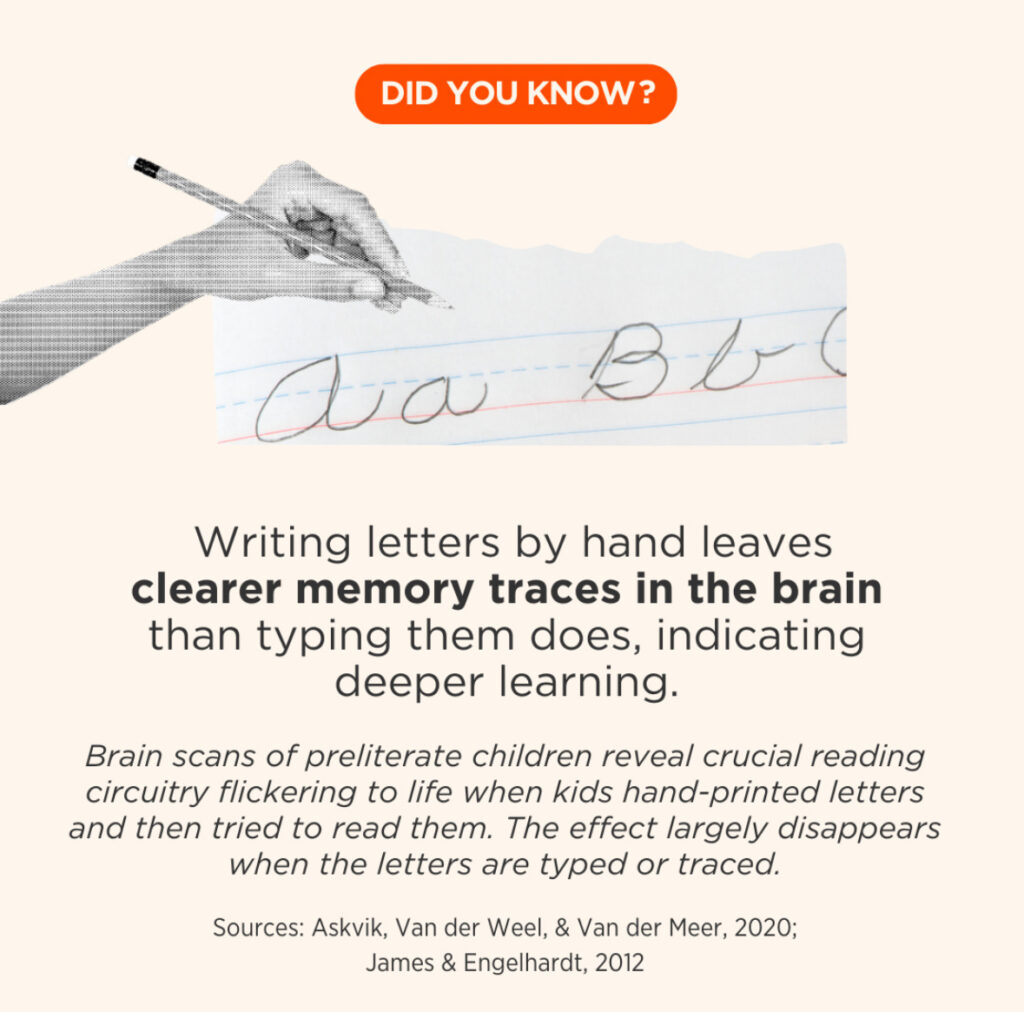
- Students who have serviceable and legible handwriting tend to write more by hand. This would include both writing text and also math computations. More importantly, students who write by hand (taking notes, creating content) tend to retain more information than even those who rely solely on keyboarding.
Now, About those Touch Screens – Swipe, Tap, Click, and Flash!
The Younger Child
Ages 0-5
As I wrote in Part 1, young children proceed to learn various fine (small muscle involving hands and fingers) and gross (large muscle) motor skills. This leads up to the ability to hold utensils for eating, painting, coloring, manipulating objects and writing. Yes, climbing monkey bars, a gross motor skill, affects a child’s hand strength…just think about itl.
Jen Judd, et. al.’s 2020 study published in The National Library of Medicine through the National Institutes of Medicine discussed the effects of screen technology usage on hand skills in preschool children. The study compared high usage touch screen technology (use for >2 hours/day) and low usage touch screen technology users (use for <2 hours/day). Differences in gender, age, number of siblings, maternal age and level of education, as well as household income were accounted for and considered.
The results, as per administration of both the Assessment of Children’s Hand Skills and Children’s Hand Skills Ability Questionnaire, overwhelmingly indicated that preschool children in the low usage touch screen technology group had better hand skills in all domains measured. Particularly noteworthy domains indicating effects of touch screen technology usage effects included Play and Leisure, School/Education, and Activities of Daily Living. The authors concluded that touch screen usage might cause disadvantages in terms of the development of hand skills.
My Add:
Excessive touch screen usage might cause disadvantages in terms of the development of handwriting skills. Touch screens often replace more traditional activities such as building blocks, puzzles, and board games. They also replace environmental manipulation of objects (buttoning, zipping, eating, shoe tying, etc.). These different types of activities impose different motor demands on children in terms of tactile and muscular experience.
“Excessive touch screen usage might cause disadvantages in terms of the development of handwriting skills.”
Lori Josephson
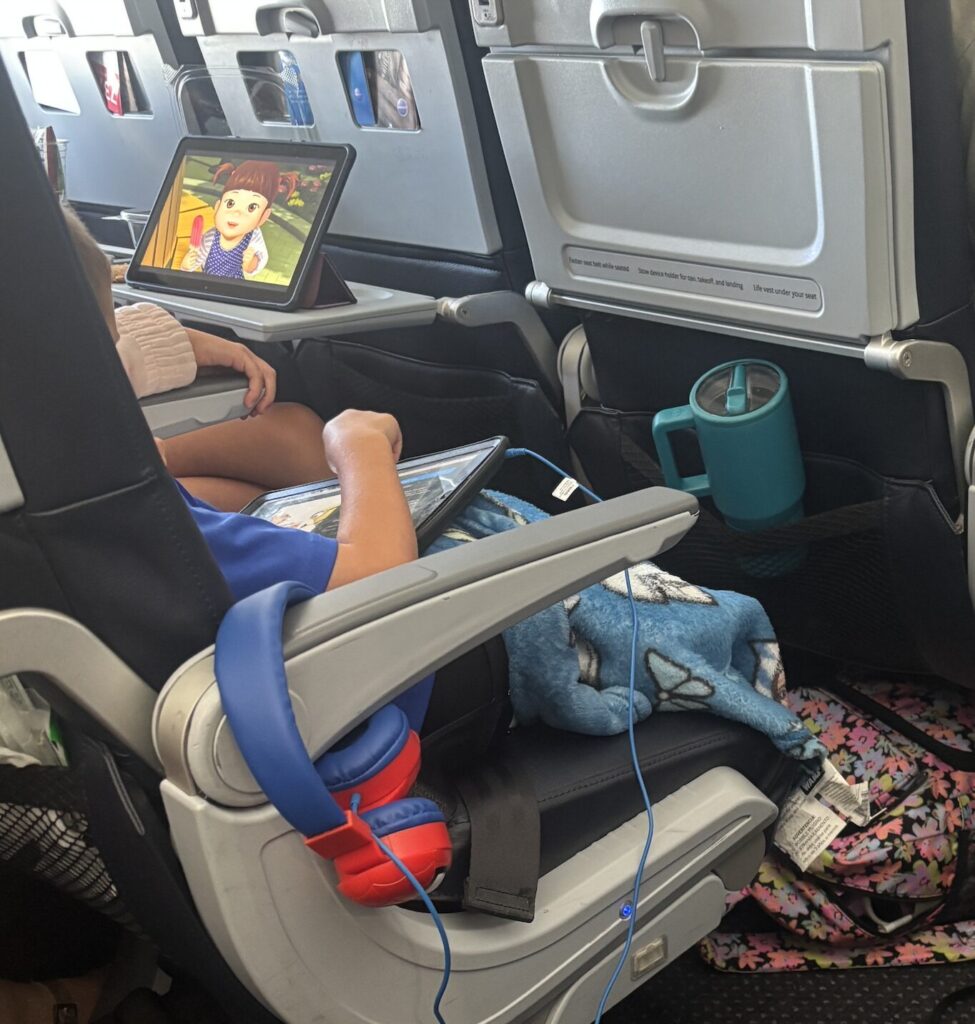
I was on one of my many plane flights this summer witnessing preschoolers simply glued to their screens. They were not watching a video, but engaged in a game involving use of only the index finger. Their mom verbally praised their excellent behavior while scrolling on her own handheld device.
Image by Lori Josephson
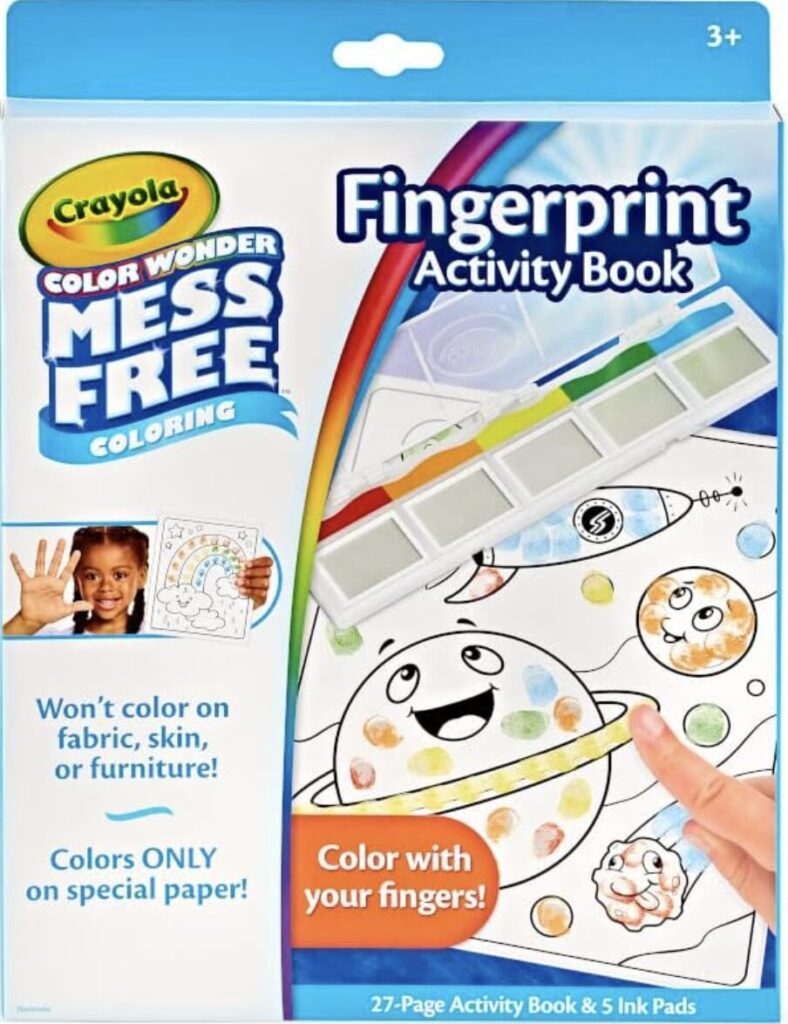
Not only were they using screens, but mom was proud to share that she found a way for her children to ‘color’ while not making a mess. She unveiled special coloring books using ‘invisible ink’! The kids simply had to touch a color from the palette and use their index fingers to ‘color’ in a coloring book.
Screenshot by Lori Josephson courtesy of Amazon
By contrast, I’ve been on plane flights where the parents actively color using old-fashioned crayons with their children and reading aloud old-fashioned books. I don’t write this to be judgmental. Please do think about the differences in terms of motor skill development, language development, and parent-child interpersonal skills development. I totally realize there is a place in this world for screen time usage with children—sometimes it is just finding time to take a shower!!! I just want to point out that mindfulness and moderation in terms of screen time usage appear top of mind IMHO.
A list from the American Academy of Pediatrics outlines guidelines on screen time usage just in case you haven’t seen it:
- Until 18 months of age limit screen use to video chatting along with an adult (for example, with a parent who is out of town).
- Between 18- and 24-months screen time should be limited to watching educational programming with a caregiver.
- For children 2-5, limit non-educational screen time to about 1 hour per weekday and 3 hours on the weekend days.
- For ages 6 and older, encourage healthy habits and limit activities that include screens.
- Turn off all screens during family meals and outings.
- Learn about and use parental controls.
- Avoid using screens as pacifiers, babysitters, or to stop tantrums.
- Turn off screens and remove them from bedrooms 30-60 minutes before bedtime.
The School Aged Child
Ages 5/6-11
There is no way to escape the prevalence of screen time usage in our current society. I. Totally. Get. It.
So many apps, so little time. So many bells and whistles, so inviting to young and old alike. As a Moderator of the popular FaceBook Group ‘Science of Reading-What I Should Have Learned in College’, I very regularly monitor posts requesting apps and online programs to help students attain literacy. I have to say I am torn about making recommendations. I say this because so much time is spent looking at and manipulating a screen with just a finger or two.
So many students receive instruction on a screen. So many less students attending our public schools. But that’s another story…read this article from Boston University.
Obviously, what comes with increased screen time is a more sedentary lifestyle. A more sedentary lifestyle may negatively affect many motor skills involved in handwriting. This includes the development of writing posture, hand strength, eye-hand coordination, and overall physical strength and dexterity. We parents and educators need to be mindful of ALL of these pros and cons concerning screen time usage.
Be a good role model in terms of minding your own screen time usage. Have your children SEE you writing thank you notes by hand, SEE you writing ‘to do’ lists, SEE you writing on an old-fashioned calendar, and/or SEE you engaging in physical movement. Parents/caregivers are our children’s first teachers. Teachers, I never did get used to using a Smart Board in favor of either a chalk board or a white board where I wrote by hand. I recall coaching a teacher who was just so relieved to find out that she did not have to use a Smart Board in favor of manipulation of letter cards when teaching phonics!
The Older Child
Age 11+
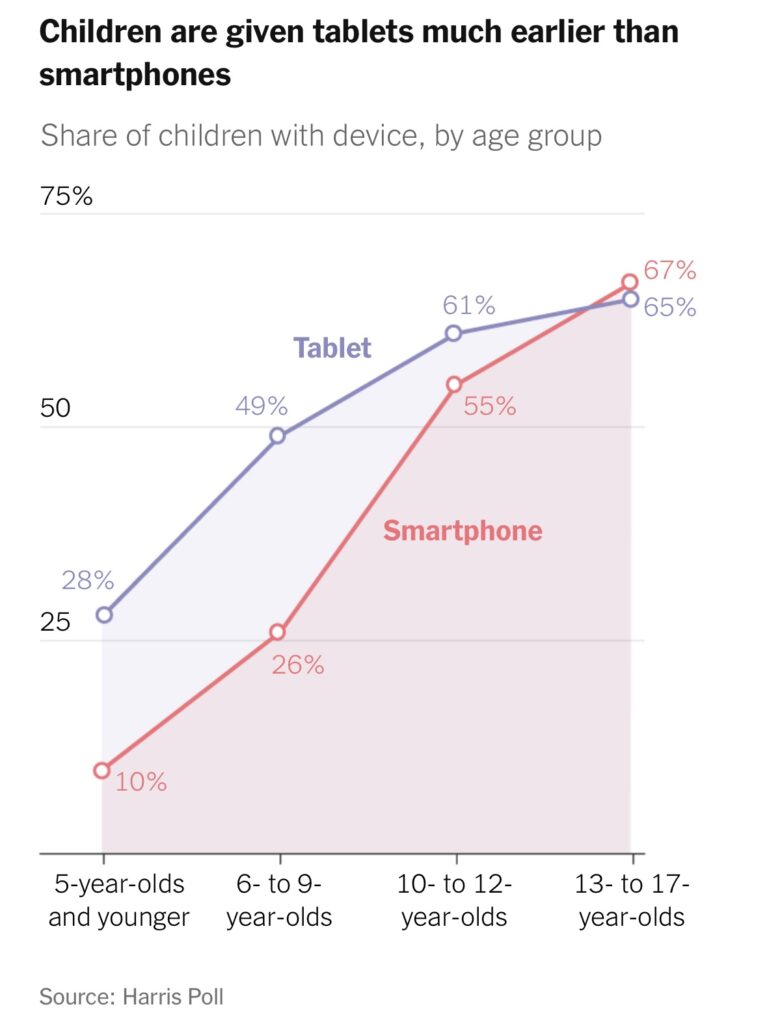
Need I say more? Just look around….everywhere—school and otherwise.
The average age 60% of children receive or have access to an iPad or Chromebook at home is age 4. This link is a more recent statistic than the chart to the left…obviously, children now have access to tablets at increasingly younger ages!
The average age a child receives or has access to a screen in the school environment is age 5-6 (kindergarten).
The average age a child receives a cell phone is now 11 years 6 months.
Source: Harris Poll
I read tales of the students who finish school work early rewarded with use of a screen to ‘play games’—often alone. I ask you, readers of this article, is this the optimal use of instructional time? I am on one side of the fence, as you can imagine…
Do note the ongoing debate of cell phone usage/banning in schools. How does this affect motor skills, writing by hand, and overall school success? I do not have the answers, but I do know many questions remain.
I welcome your thoughts, experiences, and comments. This will likely be an ongoing discussion for years to come as we learn more about the complex interactions of child development, screen time, educational experience and academic success.
For more information on Children and Screens, I suggest having a look at this website.