

July (Part 2), Coming in August (Part 3) 2025
Introduction
If you are just reading this article for the first time, I suggest you click back to my June 2025 article here, which explains the development of an appropriate pencil grip from birth to about age 5 prior to reading this month’s article.
As a prelude, here are a couple of paragraphs from my last article:
Question: When these pencil grip, writing posture, sequences of strokes for letter formation are neglected, what often results?
Answer: Poor letter formations, reduced legibility, and most importantly, reduced handwriting fluency/serviceability (ease of writing without fatigue). The child finds writing by hand laborious at best and impossible at worst. This child sometimes refusing to write by hand at all.

When formal education begins, kindergarteners are also learning to blend (/k/…/ǎ/../t/ = ‘cat’) and segment (‘cat’ = /k/…/ ǎ/…/t/) individual sounds (phonemes) starting with simple 3 letter words. Hopefully, these skills are taught in conjunction with looking at and writing the letters.
Image ©Lori Josephson 2024
What Can I Do to Improve a Child’s Pencil Grip?
Aside from working on the items I wrote about in my June blog discussing the development of a functional pencil grip, here are some suggestions for improvement as needed–and it is never too late::
1-Speak with your child or student about pencil grip and why it will be easier for them to engage at school and at home if they have a functional pencil grip. Children will be more cooperative if they understand reasons for what they are asked to do.
2-Teach them about the pincer grasp, hand strength, hand positioning, and writing posture (again, refer to my June blog).
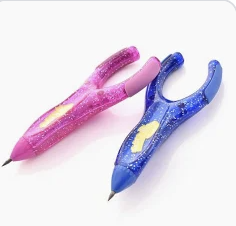
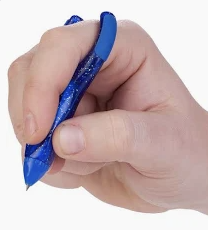
3-Practice in short sessions (5 minutes for developing writers, longer for those kids about 8 years old) using some tips and tricks listed below. Buyer beware! Many pencil grips are not worth the money (and they are inexpensive!) to produce them, let alone purchase them. Suggest you literally throw away all other tools aside from the ones pictured below:
The Twist ‘N Write Pencils insist that the writer to use a tripod grip and open web space (open space between the thumb and index finger). Do note the bent thumb and arched index finger. Also note the curved indentation for the index finger placement. It is important that students use the Twist ‘N Write consistently in both the school and home environments. These tools can be a bit pricey. Suggest checking on Amazon for the deal on the ‘barrel of them’ size. It has been my experience that students eventually switch out to a typical pencil. I am not a fan of the hard to use erasers (pictured to the size of the index finger), so I suggest having a stand alone eraser handy. A separate eraser is a small price to pay to encourage a functional pencil grip!
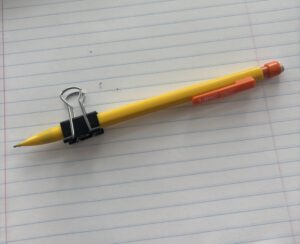
The poor man’s version of the Twist ‘N Write involves the use of an ‘elephant clip’ on a typical pencil. Much less expensive, better eraser, and provides a nearly similar level of support. Do note the bent thumb and index finger. Suggest beginning with the Twist ‘N Write and transitioning to the elephant clip.
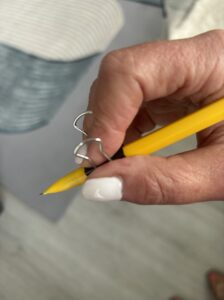

For students requiring maximal support, I suggest the Writing Frame, pictured left. Typically, students with severe dysgraphia would find this useful. As one can see, it fosters the tripod pencil grip, as well as provide support in the placement of the student’s hand and remaining fingers. Again, if one needs to work with a student using the Writing Frame, transitioning to the elephant clip would be a good option.
Screenshots by Lori Josephson
One last trick, and courtesy of Instagram, I did not have to create this video. Some students simply see this ‘trick’ and enjoy a serviceable pencil grip immediately! All you need is a small hairband!

4- Be patient! Remediation takes time and patience. And one other thing: sometimes you will be unsuccessful, but most often, this will not be the case and your efforts will be worth your time.
Top Reasons Why Children Benefit From a Functional Pencil Grip
1-Functional Pencil Grip’s Direct Connection to Literacy Development/Learning
The Younger Student
As mentioned in the prelude above, early ‘Readers-In-Training’ learn letter recognition, sound-symbol association, as well as sound blending (decoding…AKA ‘sounding out’ words) and sound segmentation (encoding…AKA ‘spelling words’). Sound blending facilitates decoding (reading), while segmenting facilitates encoding (spelling). I explain these concepts in detail in Calling All Neurons! How Reading and Spelling Happen. In fact, they are ‘two sides of the same coin’.
Image ©Lori Josephson 2024

Students best learn the foundational skills of sound blending and particularly sound segmentation when taught in conjunction with looking at and writing the letters especially when spelling. Obviously, if one writes by hand, one needs to use a writing utensil, most optimally with a functional pencil grip (tripod, quadrupod, or modified tripod or ‘artist’ grip). Many curricula aligned with the Science of Reading have students manipulating plastic letters or letters printed on tiles to practice spelling. These curricula also have students putting a pencil to paper and/or a marker to a whiteboard.
The neurons in the visual, auditory, language, and motor parts of the brain are stimulated simultaneously when a student writes,. This facilitates and maximizes learning. Utilizing a functional pencil grip aids in facilitating and maximizing the impact of the motor neurons in learning. In turn, these skills enhance (not always, but often) the entire development of literacy skills.

How many of you have said these words? “If I don’t write it down, I will forget about it.”
Image created by Lori Josephson
A word about ‘whiteboards and markers’. In my humble opinion, I am ‘all in’ as a way for students to practice letter formations and spelling with whiteboards and markers, but….I suggest providing students with thin rather than thick, bulky markers. Little hands have a very hard time using a functional pencil grip with those big, clunky markers. In addition, whiteboard/marker practice has a very different ‘feel’ than the pressure required when a child puts a pencil to paper. Far greater hand strength is required when a student uses pencil and paper as opposed to a marker on whiteboard.
Screenshot and caption by Lori Josephson


‘Readers-In-Training’ need to develop the skill of orthographic mapping. This process allows students to immediately recognize words without the need to ‘sound them out’. Actually, writing words by hand has been shown to greatly enhance and assist in this process. By the time children are 8 or 9 years old, they have orthographically mapped thousands of words. A functional pencil grip facilitates this process, as writing is less laborious.
Image ©Lori Josephson 2024
The Older Student
Students progressing through the grades will be required to copy from the board, complete worksheets and homework, take tests, and write short paragraphs ultimately leading to essays in writing. You might disagree with me, but in my years of hundreds of visiting classrooms, I routinely witnessed students writing by hand rather than keyboarding or dictating responses.
Additionally, the act of writing by hand requires eye-hand coordination, which in and of itself, aids in the reading process. Many students (younger and yes, older), actually ‘touch the text’ when reading. Touching the text is used as an aid to improving phrasing, when then improves reading fluency. And how about highlighting text using a highlighter? Isn’t eye hand coordination required for this task?
Improved Retention of Material
Indiana University Psychology Professor Karin James’, research indicates improvement in overall retention of what is expected to be learned in any subject area. Fuirthermore, taking notes by hand is better than merely listening or taking notes on a keyboard (I was personally so bummed out when I read that finding since taking notes on a computer avoids all that ‘paper’!!).
Again, I repeat, have you ever uttered these words:
“If I don’t write it down, I’ll forget about it?”
I say this all the time and if I don’t write it down, I in fact, DO forget about it!
Do not underestimate the ‘power of the pen[cil]’!
2-Development of Writing Fluency…What’s That?
Writing fluency is defined as the ease with which one uses a writing utensil on the writing surface with minimal fatigue. We know homework is 10 minutes/grades…likely the quantity of continuous writing time is similar. According to the developers of the Handwriting Speed Test (HST) and DASH (Detailed Assessment of Speed of Handwriting), as anticipated, different age groups are able to write at different speeds. Children aged 5-12 write between 5-10 words per minute, depending on their age and educational background. As children enter their teenage years, their handwriting speed generally increases due to more developed motor and cognitive skills. On average, teenagers can write between 10 to 15 words per minute.
According to Anna Barnett, et. al. of Oxford Brookes University, high school students can write up to 50% faster than elementary school students (on average 10-15 words per minute), thanks to their improved motor skills, cognitive development, and the higher educational demands. That said, it is important to note that teenagers spend less time practicing handwriting due to the use of technology, which can sometimes limit their proficiency and speed.
Another thought to add into the mix I recently heard on NPR stating “blue books” are coming back due to the advent of AI (artificial intelligence). A “blue book” is literally a book with about 20 lined pages that college, graduate, and sometimes high school students use to answer test questions by hand.

In fact, I not so fondly recall the callus on my dominant hand’s middle finger (I use a traditional tripod pencil grip) due to constant writing come middle elementary grades. Take a look at your child’s writing hand to see if he/she/they sports a callus . Locate where it is, pay attention to pencil grip.
What about letter formations? Pay attention because ease of writing often affects the quantity of how much a ‘Reader-In-Training’ is willing and/or has the capability of writing.
3-Increased Written Language Output
Tell me, do you continue with tasks you find challenging? I know that I do not!! I get them over with as quickly as possible. Don’t give me something to fix or build…it will likely be a disaster.

Same for kids and writing. If writing fluency is not in place, most of us will try to spend as little time as possible on this task.
Image ©Lori Josephson 2024
4-Improved Math Performance
I tend to write about literacy, but I ask you:
“What happens during math class to students who are asked to show their work?”
Let me tell you what happens. Oftentimes, these students, even when they supply the correct answer, lose credit simply because they chose to omit ‘showing their work’ when solving computations. Teachers are often more interested in “the process” rather than the final answers. Sometimes, teachers give ‘partial credit’ to students who show their work in writing (their thought processes) and commit the numeric equivalent of a ‘typo’. Sometimes, students are heavily penalized even if they supply the correct answer, but choose to omit showing their work. Do note that some students who manifest severe handwriting issues have difficulty organizing numbers in rows and columns (I recommend large size graph paper for those students).
Either way, if students are asked to show their work, but find writing laborious, the outcome is oftentimes not optimal. Please visit this website by Veronica Lewis (she has both low vision and and dysgraphia). Check it out!
Screenshot by Lori Josephson

Featured image by Ana Ara from Vecteezy
Coming Attractions Next Month: What About the Influence of Screen Time on Writing By Hand? Part 3
Great learning piece. My LetterMan Program: Print to cursive incorporates much of the wisdom you write about.
Stephanie,
Indeed it does!! Carry on, my friend!!
Best, Lori