

(Parts 2 and 3 in the works!)
How Does Your Child Hold a Writing Utensil?

Ages and Stages…Pre-Writing Ages 0-4
Babies are born into a world in which they are totally dependent on their caretakers, most often their parents. Although their capacity for full sensory and muscle development is intact (in most cases), these skills take a L.O.N.G. time to develop.

Since this article is primarily concerned with holding a writing utensil, I share x-rays of a child’s hand, showing the changes in a typical child’s hand (bones, muscles) at ages 3, 8, and 13. In addition, children need time to develop their finger dexterity and strength. They also must develop wrist and elbow dexterity and strength. Before age 3, the bones in children’s hands are primarily cartilage, and do not begin to ossify (harden) until age 4. The joints and muscles are still developing at that time, making formal handwriting instruction inappropriate. Thus, I do not encourage pre-school children to learn (or be expected to learn) handwriting before their bodies and muscles are ready.
Practicing handwriting too soon does not result in hastening a child’s bone growth. Exposure to handwriting may typically begin at age 4-5. Formal handwriting instruction typically begins at age 5-6.
Instead, facilitation of bone and muscle development and strength is the goal for parents and preschool/daycare teachers. We adults take some of these skills for granted and perhaps think young children can simply work on these skills informally—this idea could not be further from the truth.
Think about developing hand strength in young children. Children require the development of enough hand strength in order to hold a writing utensil:
1-correctly (several variations exist).
2-exerting appropriate pressure on the writing surface.
3-with appropriate control.
4-easily (no discomfort or fatigue).
In fact, if you are reading this article and are the caregiver or teacher of an older child who continues to exhibit difficulty holding a writing utensil, as well as with handwriting, assess this older child’s hand strength considering the 4 parameters stated above.
Younger children need to practice gross motor skills such holding on and grasping while climbing monkey bars and rock-climbing walls, as well as shoveling sand and pouring water. Going to the playground, working at the water table, or digging in a sandbox or at the beach is not just for ‘fun’!
Now, on to the fine motor or truly hand strengthening activities preparing kids to learn handwriting skills. Are you familiar with the ‘pincer grasp’? This is the innate ability humans to pick up objects with the thumb and index finger–and it is a game changer! The pincer grasp is only possible since human beings possess an ‘opposing thumb’. So…stacking blocks, threading beads onto a string, picking up and inserting puzzle pieces, and yes, turning the pages of a book, etc. all employ the pincer grasp. And you thought you were just playing with your child(ren)!!
Image from Canva AI

Additional hand strengthening exercises for this age group include, but are not limited to:
- crumpling paper.
- manipulating Play Doh. Here is a homemade recipe for Play Doh.
- using a spray bottle; opening and closing a water bottle with a ‘pull top’.
- squeezing sponges, manipulating squeeze toys, grasping balls.
- cutting with child scissors. Here is a link to a child’s first scissors allowing for adult assistance (#3 and #9 in illustration) And no ‘running with scissors’!
- finger play activities and songs (“Where is Thumbkin?”). Here is a list of finger plays.
- practicing gluing paper and other items using Elmer’s glue, as well as a glue stick.
- Fastening buttons, zipping zippers, dressing/undressing oneself, etc.
Young preschool children go through various developmental stages in order to prepare them to ‘get a [pencil] grip’!

Young preschool children go through various developmental stages in order to prepare them to ‘get a [pencil] grip’! You will notice this begins at the age of only 3 months.
Image from ilslearningcorner.com
At about age 3, many children develop what is known as a ‘palmar grip’. The writing utensil is held more in the palm of the hand with the thumb anchoring the writing utensil. This is the stage where many preschoolers use ‘fat or thick’ crayons and markers. Children of this age/developmental stage, do not color ‘in the lines’, anchor the writing surface with their opposing hand, or display true hand dominance when coloring (are they ‘righties’ or ‘lefties’?). The image on the right illustrates a child using a palmar grip.
Image from Canva AI

I am actually not proponent of using those fat or thick writing utensils once preschoolers are a bit more able to manipulate a writing utensil. Instead, Learning Without Tears sells ‘Flip Crayons’. I love these crayons because they encourage the transition from the palmar grip to a ‘tripod pencil grip’ (or quadrupod grip), and the child gets to manipulate the crayon with only their fingers in order to color with a second color. If you don’t want to purchase the Flip Crayons, you can simply break typically sized crayons into smaller segments. It is virtually impossible to hold a small 2-inch crayon using a palmar grip!

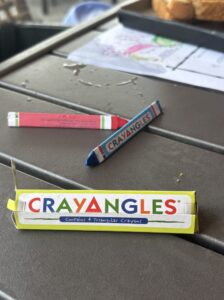
I was recently at a restaurant with a friend and her 3-year-old granddaughter. She had crayons and a kids’ coloring menu. The restaurant featured Crayangles, which also encourage a more advanced pencil grip than the palmar grip. Of course, I thought about ‘getting a grip’, while my friend liked them because, “they couldn’t roll off the table”! I hadn’t even given that a thought!
Ages and Stages…Early Handwriting Instruction Age 5 and Up
Pre-kindergarteners and kindergarteners continue to develop greater hand strength. In addition to the activities described in the preceding section, 5-6 year olds practice cutting more independently with small scissors, coloring within the lines, completing ‘dot-to-dot’ worksheets, and practicing the all important skill of tracing. Some later kindergarteners even begin to learn to tie their shoes–think about the finger dexterity and hand strength required to tie one’s own shoes! Of course, many children do not wear shoes with laces–which allow for less modeling and practice, but that’s another story–but it does help busy parents and teachers!
Often in pre-kindergarten (and for sure in kindergarten) children are working on recognizing and writing their names, as well as early pre-literacy skills involving letter recognition and sound-symbol correspondences. Just like that, formal handwriting instruction ought to begin. Children learn these pre-literacy skills far more effectively when letter formation is taught simultaneously.
Get a ‘Grip’
Formal handwriting instruction hopefully begins with the full transition from the palmar or less mature pencil grip to the functional/mature/user-friendly tripod, or quadrupod pencil grip. Let’s look at a few dysfunctional pencil grips first. These students lack appropriate control and finger dexterity due to finger placement, also resulting in much greater fatigue when writing, which then results in far less writing stamina (the ability to keep writing). Do note the pencil is not pointing toward any of these students’ shoulders.
I feel for these students. Alas, due to my vocation, I routinely observe the pencil grasps of folks around town doing their jobs…and feel sorry for the folks for whom writing is effortful. I just can’t help myself! Scroll over the photos below for more information.


It is most important for the kindergartener to possess the hand strength to hold and control the writing utensil. Student success is achieved when the pencil is held between the index finger and the thumb, with the pencil resting upon the middle finger (3 fingers—hence the name ‘tri (3) ‘pod’ [Latin for ‘foot’]). The ring finger and pinkie rest upon the writing surface, as well as the ulnar muscles of the hand. The opposing hand optimally anchors the writing surface. When the child is writing, the writing surface (paper, whiteboard) is stable. Alternatively, a child will likely achieve success with a quadrupod grip, in which the pencil is held between the thumb and index finger, but rests upon both the 3rd and the 4th fingers. Again, the bent pinkie rests upon the writing surface with the support of the hand’s ulnar muscles (pictured below in yellow).

An ‘artist’ or ‘modified tripod’ grip is a third grip which is acceptable.
The thumb is also bent in each of these functional grasps. The pencil should point back toward the student’s shoulder.
Screenshot image from DevelopLearnGrow.com
Most noteworthy is the still evident importance of the pincer grasp, initially used to grab and manipulate objects. It is now featured in the mature pencil grips I described and pictured above. The opening between the thumb and index finger is known as the ‘web space’. Go back and note the pictures of the dysfunctional pencil grips. Do note that these children typically wrap their thumb around the writing utensil, thereby eliminating the pincer grasp in its entirety.
In addition to pencil grip, students need explicit instruction in terms of the correct posture for writing (feet on the floor, sitting at a table/desk with elbows on the writing surface), and possess upper body strength inclusive of some shoulder stability.
Image from Fundations, Wilson Language with permission to duplicate

Q & A
Question: What often results when the pencil grip, writing posture, and sequences of strokes for letter formation are neglected?
Answer: Poor letter formations, reduced legibility, and most importantly, reduced handwriting fluency/serviceability. The child finds writing by hand laborious at best and impossible at worst. Sometimes students refuse to write by hand at all.
When formal education begins, kindergarteners are also learning to blend (/k/…/ǎ/../t/ = ‘cat’) and segment (‘cat’ = /k/…/ ǎ/…/t/) individual sounds (phonemes) starting with simple 3 letter words. Hopefully, these skills are taught in conjunction with looking at and writing the letters. Blending facilitates decoding (reading), while segmenting facilitates encoding (spelling). I explain these concepts in detail in my book, Calling All Neurons! How Reading and Spelling Happen.

Stay tuned for Part 2 of this article, which explains why it is important for children to write as they learn literacy skills, why using a functional pencil grip is so important, and what you can do to correct a poor pencil grip . Yes, you can remediate a poor pencil grip (sorry to make you wait, but this current article is plenty long!). Check your ‘in’ box!
Image ©Lori Josephson 2024 from Calling All Neurons! How Reading and Spelling Happen
Part 3 of this article focuses upon the influence of screens on writing development. Again, stay tuned to your ‘in’ box for more info and tips!
Image by Karolina Grabowska from Pexels

FINAL NOTE: Not every child will hold a writing utensil in a functional way, despite your (parents and teachers) best efforts. In fact, one of my own 3 children does not write by hand with one of the pencil grips I outline above. And don’t think for a minute that I didn’t work on this skill!! This does not mean that a child is not intelligent nor have the capability to learn to read and write or even struggle to attain literacy. Many a fine student has poor handwriting, making legibility difficult, which can sometimes prove frustrating to teachers. My ask: Just do the best you can.
Beautiful job expanding what I wrote in my LetterMan Program.PreWriting Instruction based on the 4 Stroke Principle.
Readers!
Yes, please have a look at my friend and colleague’s book entitled LetterMan Program:Pre-Writing Instruction.
Thank you, Stephanie Gordon, for all your contributions to our educators, families and children!
Lori J.