
Introduction: Authentic Text Is Full of ‘Book Language‘
In my October blog, entitled, PART 2…Authentic ‘text’ Books for the Main Course/Dessert—IT’S TASTIER!, I write extensively on the importance of having student exposure to ‘authentic text’ as opposed to ‘decodable text’.
In short, foundational reading students first need to spend time practicing the decoding skills they have been taught. This type of text is called ‘decodable text’. These foundational readers are then able to orthographically map the words they are reading so that they become recognized automatically without the need to ‘sound them out’. Once students are able to recognize about 90 non-phonetic high frequency words (those appearing very frequently), and can decode 1, 2, and 3 syllable words containing short vowels, simple long vowels (long ‘a’ as in ‘baby’ or long ‘a’ as in ‘name’), r-controlled vowel combinations (‘ar’ as in ‘party’), and simple digraphs (‘sh’, ‘ch’, ‘th’, ‘wh’), the transition to authentic text needs to begin.
Thus, most students practice decoding using decodable readers for a very short window. During this short window, these ‘readers-in-training’ are best served simultaneously listening to teachers and parents/caregivers read books containing authentic text, AKA ‘Book Language’.
9 Ways ‘Book Language’ is Different from ‘Spoken Language’: What Parents Need to Know
Maryellen MacDonald has a lot to say on the topic of ‘Book Language’ and how it differs from ‘Spoken Language’. She describes herself as a language researcher specializing in the role of experience in language comprehension and production,
I am a grandmother of 6, including one set of twins, ages 5 1/2 and under. My ‘grandma name’ is “GLori”! I carefully follow their oral language skills over time (no surprise!). I can well attest to the vast differences between the language adults use to speak with children and language in the many books read to and with these same children.
A quick summary as per Dr. MacDonald and other researchers is outlined in the table below:
Differences Between ‘Book Language’ and ‘Spoken Language’
| ‘Spoken Language’ | ‘Book Language’ |
| use of short phrases/simple sentences/directives/questions | use of complete sentences often containing complex sentence structures (‘Book Language’ words such as “although” and grammar such as the ‘relative clause’ often beginning with signal words ‘that’, ‘which’, ‘for’) |
| discussion of everyday topics with shared knowledge basis and shared goals and attention | discussion of a wider range of topics without shared attention with the goal of sharing information |
| use of everyday vocabulary words such as “bedtime”, “eat your lunch”, etc. | use of less common, more precise/sophisticated vocabulary words often containing prefixes and suffixes (longer and more morphologically complex such as “unenthusiastically”) |
| use of pronouns | use of specific nouns and adjectives featuring descriptive and emotive language |
| use of informal grammar inclusive of ‘fillers’ such as “um”, “you know”, etc., often signifying ‘thinking time’ and speed/flow of conversation | use of sentences aligned with formal grammatical rules |
| use of tone and nonverbal cues (body language, facial expression, tone, environmental surroundings) to provide meaning | use of the text to provide all context of language and meaning |
| discussion ‘in the moment’/immediate ‘back and forth’ conversation (synchronous) | no immediate response required in real time (asynchronous) |
| discussion is casual and dynamic | discussion is formal and permanent (it’s in print!) |
| discussion includes less exposure to ’emotionally laden’ words | discussion includes more exposure to ’emotionally laden’ words (Perhaps this may impact development of SEL [Social Emotional Learning]?} |
Just take a look at this illustration. It provides specific examples of different parameters and vocabulary words contrasting ‘Book Language’ with ‘Spoken Language’!
Image from the open access 2022 article entitled, “Book Language and Its Implications for Children’s Language, Literacy, and Development” by Kate Nation, Nicola Dawson, and Yaling Hsiao.
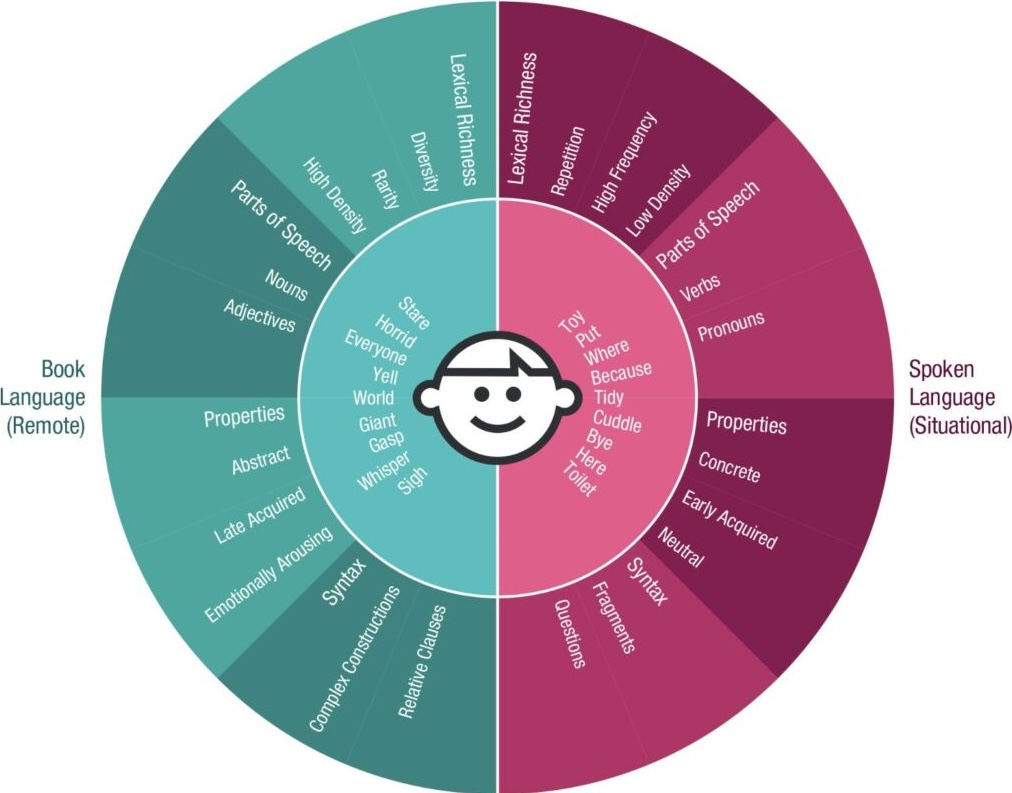
If you look at the inner circles, you can see the different types of vocabulary corresponding to the concepts in the outer circles. I agree, this is A LOT to take in!!
Examples of ‘Book Language’ From, Well, Real Books
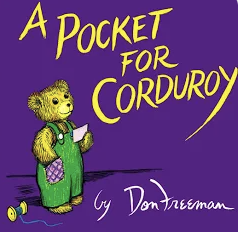
“Without hesitating, he climbed inside the bag, which was filled with pieces of wet laundry. The dampness didn’t bother Corduroy in the least.”
Do note the phrase beginning with ‘which’ describes the bag. Many children would have difficulty understanding this long sentence in this simple picture book.
Also note the more specific vocabulary selection of ‘hesitating’ and ‘dampness’, as well as the figurative expression ‘in the least’. Many children may also not easily realize that ‘he’ refers to Corduroy, the stuffed bear.
Screenshot by Lori Josephson
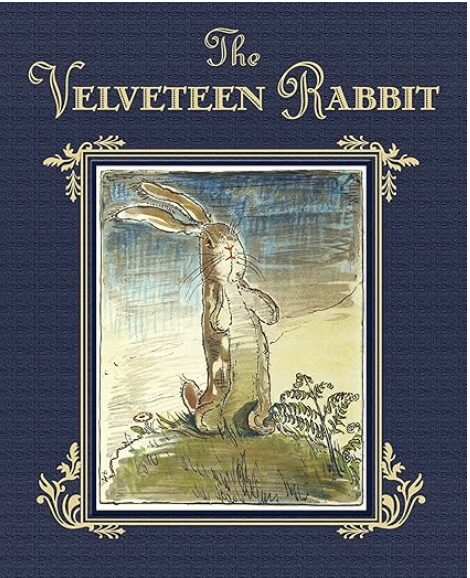
And let’s not forget the classic children’s book (suggested for children ages 4-8!), The Velveteen Rabbit by Margery Williams. I want to point out that this book was first published in 1922. Children’s language certainly has evolved, but language is ever evolving!
“The Rabbit could not claim to be a model of anything, for he didn’t know that real rabbits existed; he thought they were all stuffed with sawdust like himself, and he understood that sawdust was quite out-of-date and should never be mentioned in modern circles.
Now the sentence above is rather lengthy and includes high level vocabulary words and phrases such as ‘claim’, ‘existed’, ‘sawdust’, ‘out-of-date’ and ‘modern circles’.
Screenshot by Lori Josephson
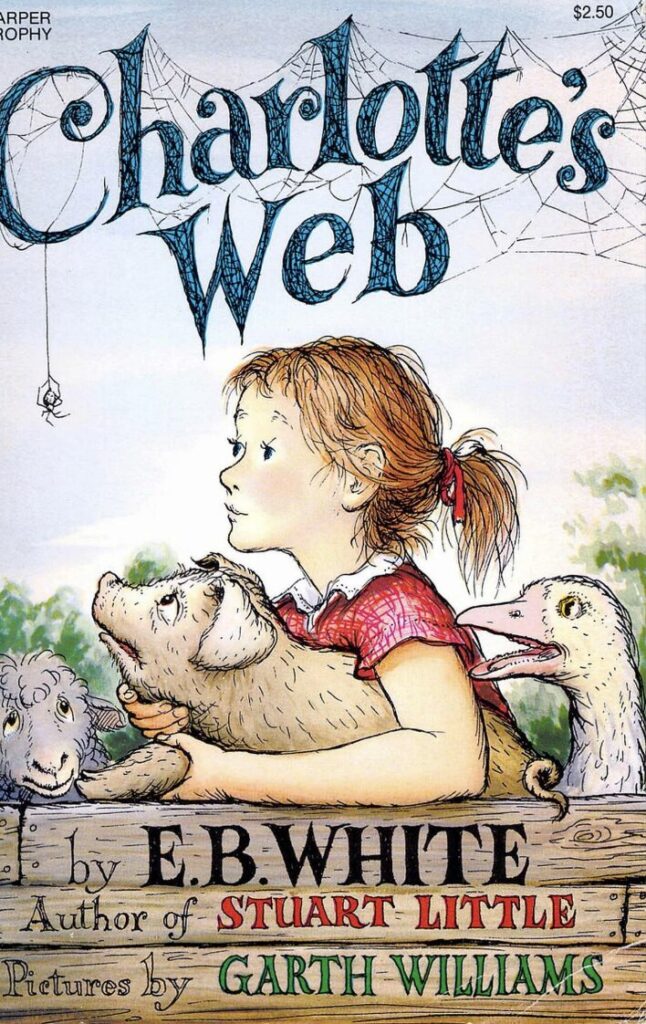
And let’s not forget the classic often whole class read aloud in many first grade classrooms, Charlotte’s Web.
“Wilbur was merely suffering the doubts and fears that often go with finding a new friend. In good time, he was to discover that he was mistaken about Charlotte. Underneath her rather bold and cruel exterior, she had a kind heart, and she was to prove loyal and true to the very end.”
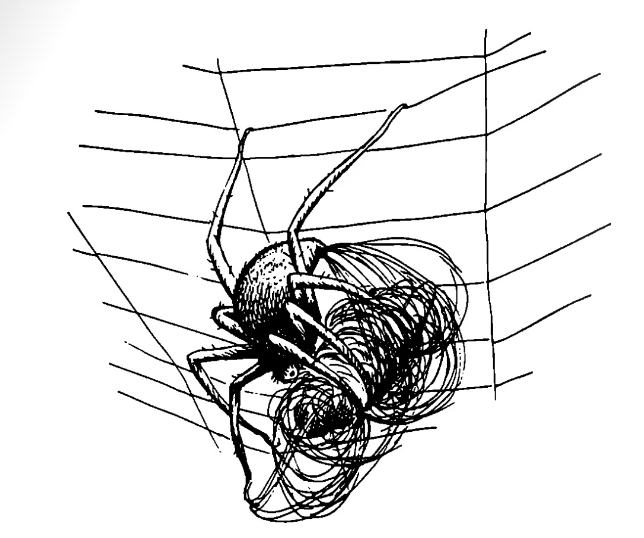
Now this is a lot to unpack for most 6-year-olds!
Note the italicized relative clauses, as well as the paragraph chock full of conceptually high level vocabulary and phrases: ‘merely’, ‘suffering’, doubts’, ‘often go with’, ‘in good time’, ‘mistaken’, ‘underneath’, ‘bold’, ‘cruel’, ‘exterior’, ‘loyal and true’….I hope adult readers spend a good deal of time discussing this single passage about Wilbur the pig and his new friendship with Charlotte the spider.
It is this very type of interpersonal interchange that fosters the development of empathy between human beings; and that which separates humans from animals! Ironic that is it the animals that serve as the role models for humans reading or listening to this classic story.
Screenshot by Lori Josephson
WHY Exposure to ‘Book Language’ Is Important for Our Kids
Authors depend on descriptions of scenes and characters using less familiar and more emotive vocabulary. This is because the readers are literally “not in the same room”. Since many of these words are not encountered as much when children are engaged in spoken language, they are by definition ‘unfamiliar.’ That said, exposure to the vocabulary used in books becomes vital. The vocabulary used in ‘Book Language’ helps grow children’s vocabularies and increases their reading proficiency and comprehension.
Not only is there a greater variety of words used in books (as compared to spoken language), but also far more complex sentence structures. Sentences found in books are far longer and contain what are called ’embedded clauses’. Many of these are ‘relative clauses’ (often beginning with the words ‘which’, ‘that’, or ‘for’. Go ahead and review examples in the previous section).
Additionally, many students have difficulty with pronoun referents encountered in books. These sentence structures begin appearing in picture books. They become far more prevalent as children progress through the grades into chapter books and informational text. In fact, psychologist Jessica Montag found that relative clauses were 6-50 times more frequent in picture books than in child directed speech.
Thus, although many students have adequate decoding skills to read single words and even phrases, they sometimes begin to encounter difficulty with comprehending the vocabulary and more complex sentence structures. This is true especially as they advance to the upper elementary grades.
As Dr. MacDonald states, “…this becomes a classic Catch-22…children need to know about ‘book language’ in order to read fluently, but the speech they hear doesn’t give them the opportunity to get this knowledge.” Obviously the only way for children to gain knowledge about the patterns of ‘Book Language’ is from repeated exposure to and practice with reading books containing ‘authentic text’. Of course, parents, caregivers, and educators can and ought to assist in helping what I call ‘readers in training’ develop ‘book language’.
Takeaways and Final Thoughts (for now)…
As Maryellen MacDonald, says, “Speech is necessary, but not sufficient to learn ‘Book Language’ to become a fluent reader.”
Come back to read a future article, which will address ‘Next Steps for Children’ in each age group. You will learn more about what you can do to help your children develop a greater handle on ‘Book Language’. I’ve given you enough food for thought for now, don’t you agree? Look for Part 2 in the coming weeks!
‘Spoken Language’: “Thanks a lot for reading this article to the end.”
‘Book Language’: I sincerely applaud your ability to read this article in its entirety.”
As an educator and great grandmother, your article here gives me food for thought, Thank you! Now, i just need to find Part one to bild upon age specific language both book and spoken.
Hi Judithanne!
Here you go for Part 1: https://lorijosephson.com/2026/what-parents-need-to-know-about-book-language-whats-that-anyway-part-1/
Thank you for your interest!!
Lori