
Prelude
In January, I started writing about ‘Book Language’ and its importance in attaining school success. You can read this article here.
To summarize, ‘Book Language’ differs from spoken language in significant ways. ‘Book Language’ is written using complete sentences including longer and more complex sentence structures. The vocabulary is far more descriptive and evokes more emotions. Greater usage of nouns and adjectives prevails rather than the pronoun usage and phrases apparent in spoken language. ‘Book Language’ covers a wider range of topics, both fiction and non-fiction. Alternatively, spoken language addresses common everyday tasks and vocabulary familiar to children. In addition, ‘Book Language’ totally depends on what is written in the text (no environmental cues such as tone or gesture), with no immediate response required. The language in books is permanent with the ability of revisiting the text again and again.
These days, the development of ‘Book Language’ appears more front and center to me given what we know about The Science of Reading. To date, over 70% of today’s students do not read even at the ‘proficient’ level. This statistic has remained constant over the past 20 years. Regrettably, it appears that school shutdowns/remote learning and then reopenings with additional government funding for intensive tutoring have not moved the needle significantly. Even the adoption of more evidence-based curricula aligned with SOR has not resulted in universal overall growth.
Most recently there’s been a lot of buzz about the overlap of DLD (Developmental Language Disorder) and dyslexia/other reading disabilities. I can’t help but think part of the problem has to do with students grappling with increasingly difficult ‘Book Language’ as they pass through each grade. The diagnosis of DLD is often overlooked, but this is a topic for another day. I will say it has come to light that DLD often co-morbidly exists with a reading disability (to the tune of 48%! Nearly half of those with dyslexia also have DLD). Again, I can’t help but think the weakness in ‘Book Language’ goes hand in hand with DLD—just my humble opinion.
What can we do as parents, caregivers, and educators to enhance ‘Book Language’ and therefore, academic success?
Just continue reading….
Babies and Pre-Readers
‘Book Language’ development literally begins when babies and toddlers sit on the laps of adults reading board and picture books aloud. Not only is ‘Book Language’ evident even in the simplest of books, but reading to babies and young children fosters a loving bond between the young ones and the adults closest to them.
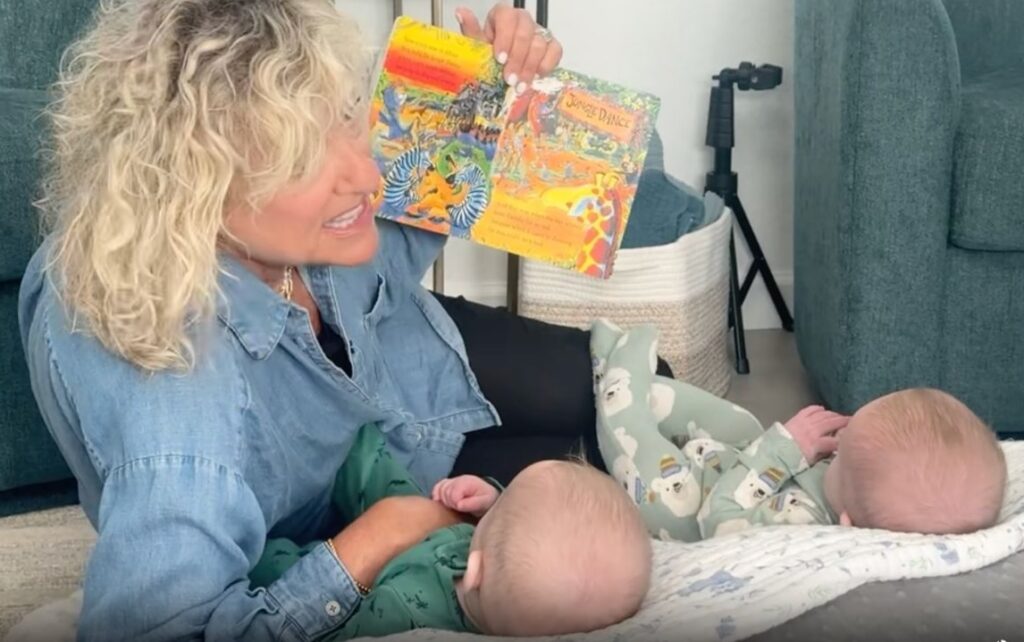
Just yesterday, I returned from helping to care for my daughter’s 6-month-old twin boys. Of course, all of the adults in the room spent a good deal of time speaking to them. Routinely, when a book was placed in front of their eyes, they immediately focused, paying intense attention to the oral language and pictures in the books.
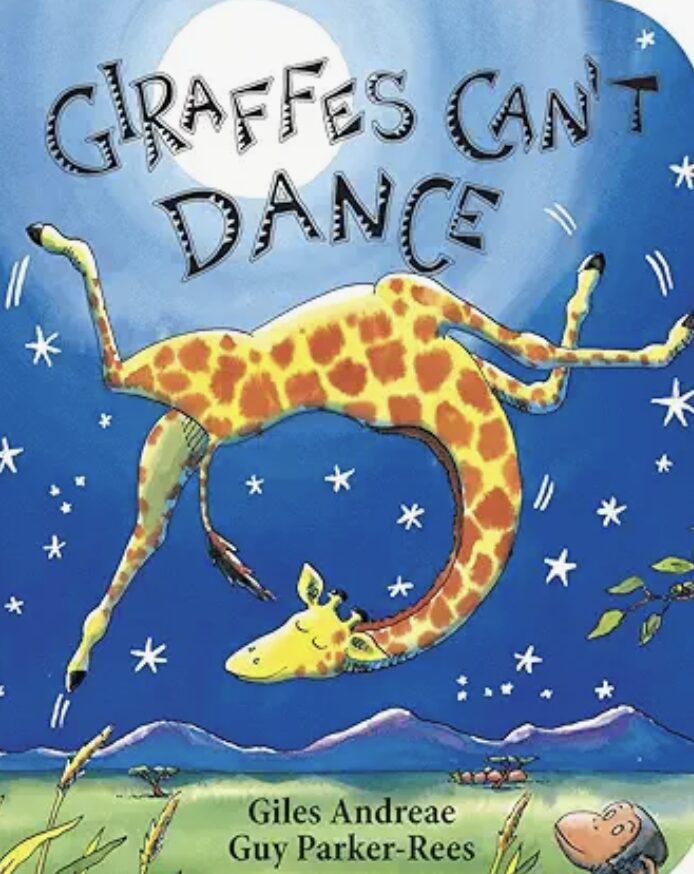
For example, when reading Giraffes Can’t Dance, I noticed:
–language evoking empathy and emotion describing Gerald’s feelings when he could not dance like other animals
–sentence structure repetition: noun + verb + object (The warthogs started dancing)
–sophisticated vocabulary: tall slender, awfully crooked (describing knees) and rather thin (describing legs), munching shoots (from trees), buckled at the knees, words for ‘dance’: waltzing, rock ‘n rolling, danced a tango
Image by Lori Josephson
Dawson, Hsiao, et.al. reported that “even books written for preschoolers contain more emotion words than child-directed speech does, suggesting once again that opportunities for learning start early. Dyer points out that words such as “feel,” “think,” “want,” and “know” appear often in board and picture books.
Furthermore, Zuk’s et.al. study points out the how a book is read to a young child has positive effects on later language comprehension. More specifically, adult readers who read with prosody (appropriate phrasing and expression) positively affect how well language is understood right then and also in the future when these children are learning to read themselves. Have a watch and a listen of me reading the same text from Giraffes Can’t Dance below—once with appropriate prosody and again just ‘reading the words’. Do note the exaggerated voice pitch and volume, which very young children seem to enjoy. They also enjoy listening to books such as Goodnight Moon in a whisper. This book is typically read as a ‘wind-down’ right before bedtime.
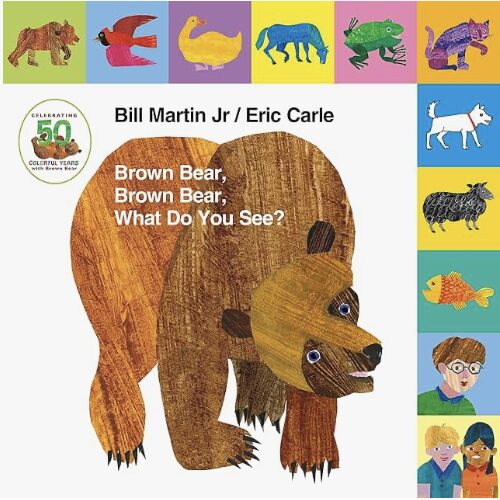
Many toddler and pre-school age children will actually ‘memorize’ entire books and look as if they are reading. While not actually reading, they ARE utilizing book language. Many a child ‘reads’ books such as Brown Bear, Brown Bear, What Do You See? In so doing, they learn and practice ‘Book Language’ skills such as:
- repetitive sentence structures (subject + verb + object phrase with an adjective placed prior to the noun + adjective phrase relative clause [looking at me]. For example, “I see a red bird looking at me.”
- Vocabulary featuring animals, color words, familiar people (teacher), pronouns ‘you’, ‘me’, and ‘I’ (“Brown bear, brown bear, what do you see? I see a teacher looking at me.”
Had you ever given any of these language features a thought? Most readers do not, I assure you. Additionally, Brown Bear’s repetitive and rhythmic nature lends itself to the future development of reading fluency later on.
Image by Lori Josephson
Finally, Ohio State’s Jessica Logan’s 2019 study found that children who were read to only 1 book per day would have heard close to 300,000 more words than children who did not read on the laps of parents/caregivers regularly.
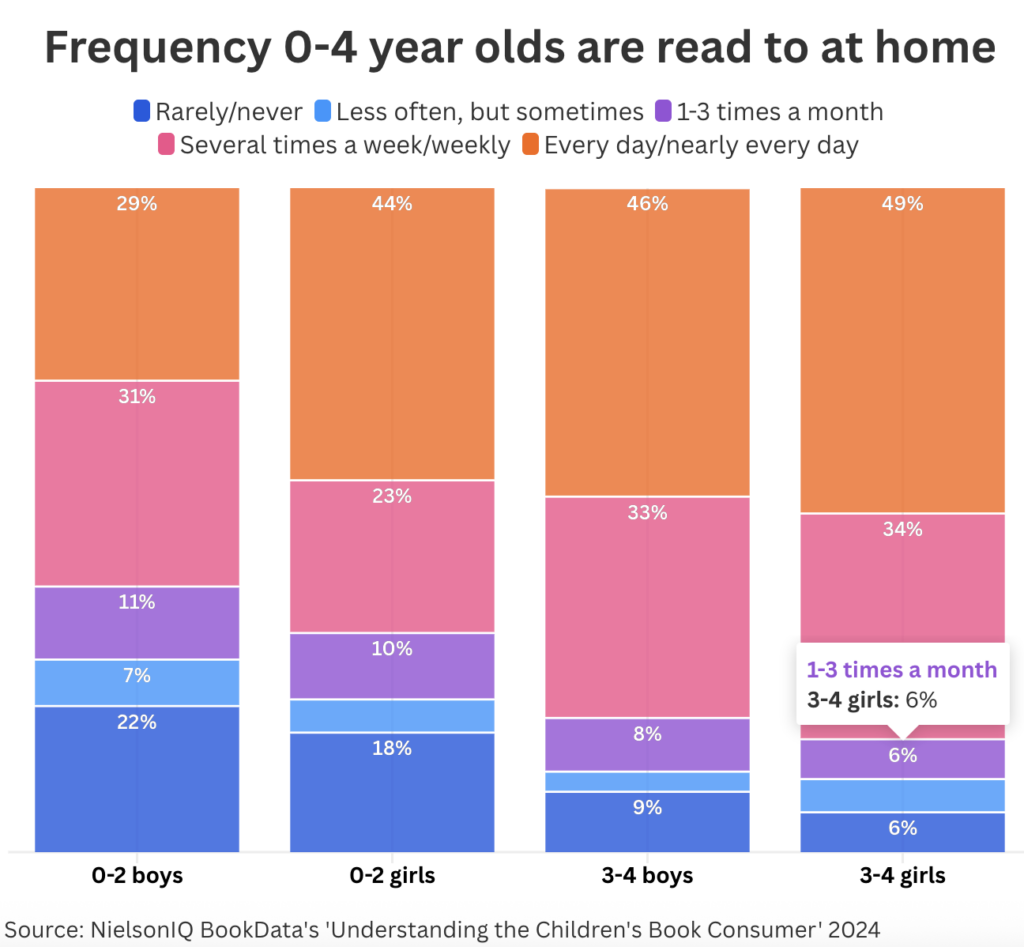
It is often the case that “a picture is worth a thousand words.” Just have a look at this 2024 survey from NielsonQ to “understand the children’s book consumer.” As you can see, no more than half of children are read to nearly every day between the ages of 0 and 4. More frightening are the results indicating 12%-40% children are never/rarely/sometimes listen to books read aloud in the home environment. Very broadly, girls seem to have an edge over boys, so it is possible this early listening to ‘Book Language’ may have a causal relationship to higher academic achievement observed in girls. Of that I am not sure, but it made me think about it.
Foundational Readers- Grades K-2
Let’s shift the focus to school aged children who are first learning to read.
Again, according to Jessica Logan’s OSU study, it is estimated that by the time a child enters formal schooling in kindergarten, those children who have been read to five times a week (not even daily!), will have experienced an additional 1.4 million words over those who have not been read to. As Dr. Logan posits, ‘the cumulative effect of reduced exposure to book language is likely to be large.” My add: The cumulative effect of reduced exposure to book language is likely impacting the ease with which foundational readers ‘crack the code’ and also develop listening/reading comprehension, as well as the development of empathy and social-emotional learning. I turn to the work of Dr. Maryanne Wolf, who consistently emphasizes the development of empathy in her talks and writings.
Do note that I am NOT saying that if a parent/caregiver reads to their children, all will be well when they are formally learning literacy skills. I have worked with many a struggling reader/speller/writer whose parents said they read to their children nightly (and I believe them). School personnel often told these same parents they should have read more to their children at home and advised to read more at home when their children encountered difficulties learning to read and spell. Let me tell you how infuriating these statements were to parents who were indeed ‘doing the right things’.
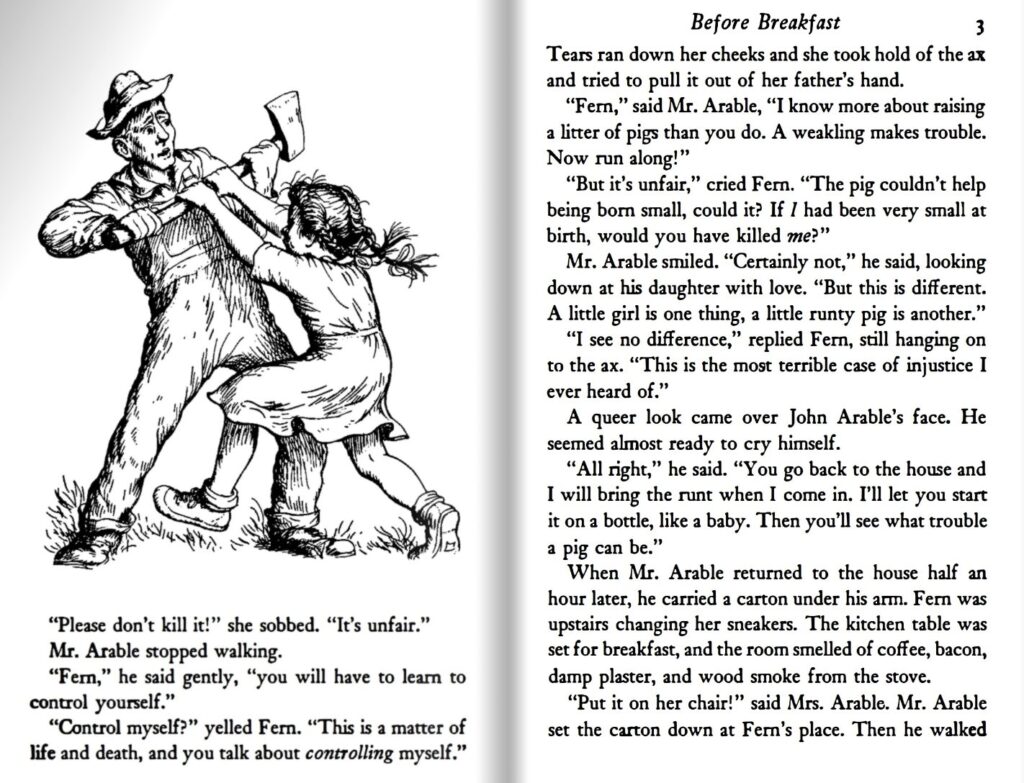
Let me share just one example from Charlotte’s Web, typically read to first graders, which helps children develop a sense of empathy for others, as Fern is aghast at her father’s desire to dispense with the beloved WIlbur the pig. Just read the pages to the left. Any child listening to these pages would want to save Wilbur!
Screenshot by Lori Josephson
Let me shift a bit to what I refer to as ‘decodable text’. These are the ‘not so interesting ‘ books you may see your child reading either in school or at home for practice. These types of books are to be used for a short window while students are learning to ‘crack the code’ of English.
While children are practicing decoding, they ought to continue with ‘read-alouds’ both in the school AND home environment. These types of books are referred to as ‘authentic text’.
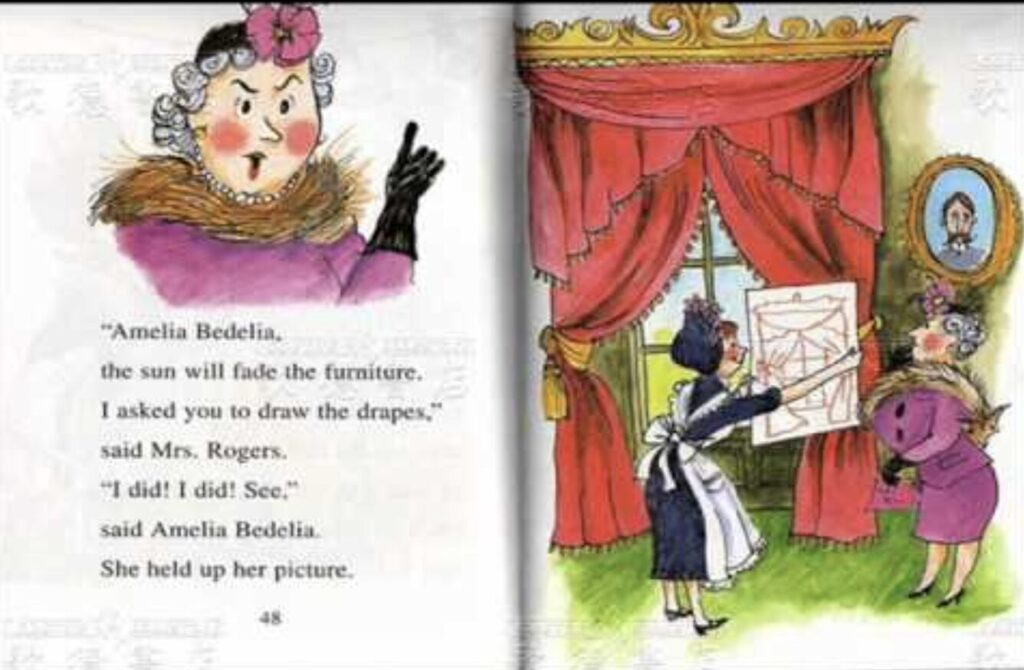
Authentic text books tend to be longer than the typical 24 page picture books read to children prior to entering school. Both authentic text books and picture books contain ‘Book Language’—let’s not shift away from the topic at hand. In addition, foundational readers begin to learn about figurative ‘book language’, as is demonstrated in the perennial favorite, Amelia Bedelia.
Screenshot by Lori Josephson
This age group typically can develop the ability to listen to longer passages. That said, they need discussion along the way. Simply reading to children without discussion will not give the ‘biggest bang for your parenting or teaching buck’. Most teachers understand and practice these strategies in the classroom.
A parent may not be aware of the following guidelines to optimize reading with school age children:
- Pre-read the passage prior to reading with your child—be sure you are familiar with the ‘book language’ you are sharing
- Continue to read with prosody—pretend you are an actor on a stage. When the characters change, change your voice—it’s fun!
- Stop at unfamiliar vocabulary words—ask if the word is familiar—explain in child friendly language I find the Collins CoBuild Dictionary to be a great resource! It explains the meanings of words in child-friendly language as opposed to a stilted ‘dictionary’ definition. It also provides a sample sentence with the word’s usage.
- Do not take for granted that your child will be able to sort out various pronoun referents. Who is ‘he’, ‘she’, ‘I’, ‘them’, ‘they’ referring to?
- Ask child to retell what has been read—can do at sentence level and work up to paragraph level. It is perfectly fine and advisable to model a retell for your child—and then ask your child to repeat what you modeled.
- Avoid starting by showing the child(ren) the illustration. Instead, display the illustration after the retell to see if the ‘mental pictures’ match…you can even have child draw a picture and then describe the picture drawn.
- It is perfectly fine to reread a passage, or read a shorter version as is necessary.
- When reading chapter books, review what happened where you left off prior to moving on—as an adult, sometimes I need to do that myself!
- Make every attempt to provide repetition of new vocabulary and even sentence structure in the home environment. It may be wise to take notes on the vocabulary taught.
- Take the opportunity to discuss the emotions and feelings the various characters in read- alouds display. Take it a step further and relate it to your child(ren)’s experiences in the home environment.
Finally, utilize our public libraries! Get your child(ren) their own library cards and emphasize the importance of our valuable public resource. Go to the library regularly, and have the child select some books of interest. Including non-fiction books is perfectly fine.
Image by Pixabay
In Closing
As cognitive psychologist Maryellen MacDonald says, “‘Book Language’ is almost as if children have to learn a new dialect” as compared with spoken language. Dr. MacDonald refers to this new dialect as a ‘register’. I couldn’t agree more!
My next and final segment on this topic will offer suggestions for children who are late elementary school age and older. The development of ‘Book Language’ is an ongoing process. Come back to ‘read all about it’!
Hi Lori,
Loving learning more about book language. My daughter & son-in-law read to their 2 & 4 year old boys every night and when we babysit, it is definitely the routine follows bath time and before lights out and songs. In fact, the 2 yr old loves to pick out his books for the evening. Your information is so important.
Karen L
Karen,
Glad you like it!! I think this topic is so important as well!! Be well.
Lori