
Recap of Parts 1 and 2
You can read the full pieces I wrote in January and February, but here is a short recap:
- I define ‘Book Language’ and how it differs from ‘spoken language’.
- I provide evidence for the importance and value of ‘Book Language’ beginning in infancy as a precursor for literacy development.
- I examine examples of ‘Book Language’ from picture books, as well as beginning chapter books. It is vital to emphasize the importance of exposure to the language appearing in print. Especially true in the early elementary grades.
- I discuss ways in which parents can maximize language (vocabulary, sentence structure, comprehension) development when engaged in reading aloud to and with children. Guess what? Teachers can benefit from these suggestions as well!
- I emphasize the need to share ‘Book Language’ with our children in order to develop empathy and connection with others. These concepts are crucial for our young ones to develop in our increasingly ‘digital world’. It is so easy for our society to become addicted to screen time. After all, I suspect you are reading this article on a screen!!
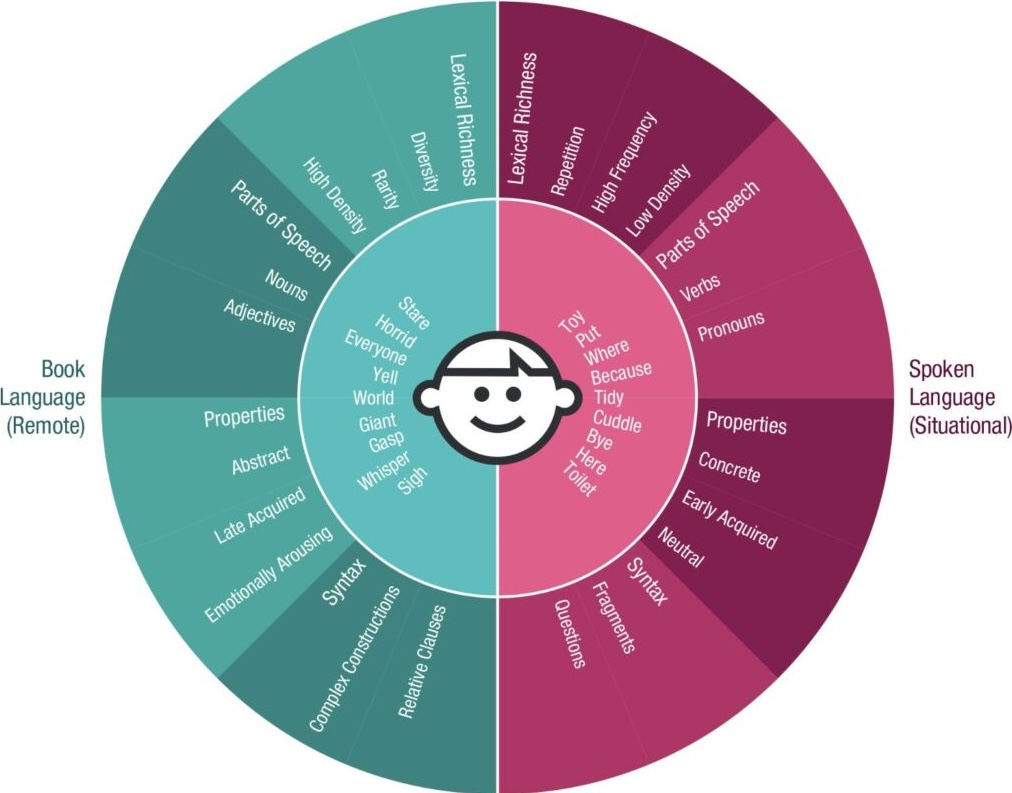
I want to again share this graphic with readers. This is one of those where a ‘picture is worth a 1,000 words’! It demonstrates the differences between ‘Book Language’ and ‘spoken language’ beautifully.
Image from the open access 2022 article entitled, “Book Language and Its Implications for Children’s Language, Literacy, and Development” by Kate Nation, Nicola Dawson, and Yaling Hsiao.
‘Book Language’ for Grades 3-6
By the time students enter Grade 3, it is wrongfully assumed that nearly all have ‘cracked the code’ of the English language. For some, this is certainly true, but for others, reading (and spelling) has become a true chore and obstacle for learning. The only enjoyment these kiddos derive from the printed word comes from listening to others read to them. In addition, becoming a proficient reader (speller and writer) takes many years and is an ever evolving process. That said, continuing to read aloud to and with children is actually A MIUST.
Elementary students learn from both narrative (fiction) and expository (non-fiction) texts. These texts feature ever increasing levels of complex vocabulary in all subject areas. Also, did you know that upwards of 40-84% of words are polysemous? Polysemous words are words carrying more than one meaning such as ‘cap’. A quick search reveals that ‘cap’ has upwards of 10 definitions. And… ‘cap’ can be used as a noun or a verb! Research (2020) out of Princeton University concluded that even toddlers were aware of multiple meaning words used in everyday spoken language. For this reason alone, elementary students benefit greatly from discussion/mediation of what is read both silently and orally with an adult teacher or parent/caregiver.
I again refer you to the list of suggestions outlined in my previous article. These same suggestions hold true for this age group.

Most children read this classic book at age 10. Below is a passage demonstrating complex sentence structures with embedded clauses, multiple meaning words (polysemy), and the notion of empathy. Talented author Lois Lowry explores the atrocities of the Holocaust designed for young readers, evoking imagery and empathy in this historical novel.
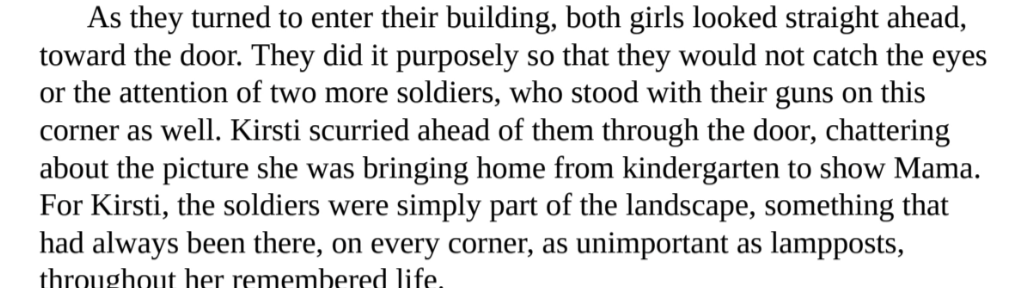
There is a lot to unpack in this one paragraph. Do note the following:
- Use of pronoun referents–to whom does ‘they’, ‘she’, ‘it’, ‘who’ refer? Pronouns are often confusing to young readers, requiring adult
mediation. - Complex Vocabulary: purposely, scurried, chattering, landscape (multi-meaning word–in this case, ‘landscape’ refers to the overall scenery as opposed to shrubs, trees, and flowers and ‘catch’ as in ‘catch the eye’ as opposed to ‘catch a ball’).
- Use of embedded relative clauses: “They (Kirsti and Annemarie) did it purposely so that they would not catch the eyes or the attention of two more soldiers, who stood with their guns on this corner as well.”
- The imagery focusing on getting through a tense situation, even for young children. Thus, Ms. Lowry evokes empathy and identification for young readers.
Screenshots by Lori Josephson
Text from a 4th grade social studies text: “Canal locks are necessary to allow boats and ships to navigate waterways with different water levels, effectively acting as ‘elevators’ for vessels by means of raising or lowering them between sections of a canal or river. They do their jobs using both gravity and water pressure.”
Note the complex sentence structure, the possible confusion of the definition of a ‘lock’, high level vocabulary (navigate, vessels, gravity, water pressure), and pronoun referents (they, their).
It is almost guaranteed that many students will be confused! Many students, familiar with the notion of a ‘lock’ as something with a combination or a key, would be lost without adult mediation. This text appears in Ohio History in grade 4!
Screenshot by Lori Josephson

‘Book Language’ for Grades 7 and Beyond, Including College Students!!
Let me simply provide readers with a couple of examples from middle and high school texts from commonly assigned books and plays such as Lord of the Flies, and Romeo and Juliet. I suggest you revisit these texts with an eye for difficult sentence structures, high level vocabulary, etc. Middle and High School students continue to benefit from reading aloud with teachers and parents/caregivers helping to mediate ‘Book Language’. This is especially true for students who continue to struggle with decoding, especially those long multi-syllable words. These struggling readers benefit greatly from listening to these higher level texts easily available via public libraries, Audible app, Bookshare, and Learning Ally (for those with documented reading disabilities such as dyslexia). Learning Ally maintains an audio library for non-fiction textbooks too!

Just try unpacking this paragraph from William Golding’s Lord of the Flies.

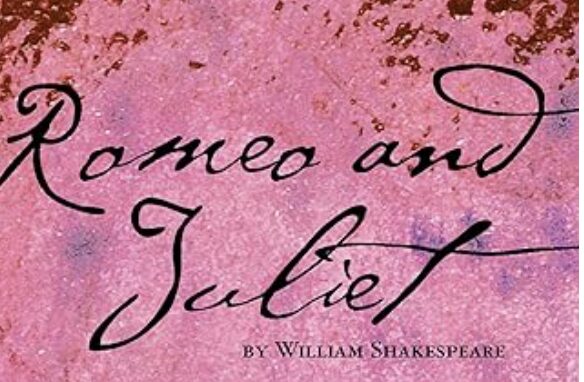
How about this passage from Romeo and Juliet?
Many students simply cannot unpack the unfamiliar sentence structures and uncommon vocabulary of this classic Shakespearian play. I recall enhancing my own comprehension by listening to a record (yes, black vinyl–I know I am dating myself!) of the Shakespearian plays I was assigned in college!

The only difference is the demands on students, which continue to escalate as they move through the grades. The texts become more complex with longer/more difficult words and longer sentences, requiring greater demands on reading stamina on the students’ parts. In a short time, ‘Book Language’ evolves into what is known as ‘academic language’. Have a look at this paper by Freddy Hiebert of The Text Project.
I once taught a student whose parent called me saying, “My daughter reads at the 8th grade level, but comprehends at the 4th grade level. Can you help her?” This was no joke. My response: “Your daughter likely decodes like an 8th grader, but her reading is likely that of a 4th grader. Since the ultimate goal of reading is understanding printed text, this young lady truly only did read for understanding like a typical 4th grader. I will also add that although this student’s spelling was fairly intact, her written language was confusing to the point of unintelligibility. These deficits were clearly obvious during the diagnostic assessment I completed. This student and I worked together to improve her comprehension and written language over the course of a couple of years.
WARNING: Do not take for granted that students’ comprehension matches their ability to decode.
I typically posted a quote on my door for incoming students to ponder if they arrived early for a lesson. One day, I posted:
“As we express our gratitude, we must never forget that the highest appreciation is not to utter words, but to live by them”. ~ John F. Kennedy
This student read this quote, immediately responding, “That is how I used to read a book. I could read the words, but I didn’t understand them.”
I thought, “Wow!” at the time, and I continue to think, “Wow!”, especially when I think about all the older students with similar learning profiles.
Final Thoughts
Two items I wish to emphasize:
Number 1: NEVER STOP reading with children, even if they are proficient readers, spellers, and writers. One of my former student’s mother once said to me, “I don’t have to read with M. anymore since she knows how to read.” In all honesty, nothing could have been further from the truth. Although M.’s decoding difficulties vastly improved over time, M. had severe comprehension issues, which persisted throughout high school. She ‘could read the words’, but she ‘didn’t necessarily know what they meant’ and oftentimes missed both the gist and details.
One of my biggest regrets as a parent myself is not reading more with my own children. While my husband and I did read the books assigned for summer reading and discussed them with our children, we all read most of them independently—if I could get a ‘do-over’, I/we would be reading with them!!
This brings to mind the notion of the family listening to books, particularly on road trips. That, we did. I fondly recall listening to Bill Bryson’s A Walk in the Woods: Rediscovering America on the Appalachian Trail despite protestations from my then 13-year-old son and his friend in “the way back” of our van. They claimed they weren’t listening. That is, until a particularly humorous section was heard in the van. Of course, you know they had been listening all along! And so, we got to discussing the book after all. This 13-year-old ended up becoming an avid hiker who completed several segment hikes of the A.T.!
Number 2: I have been reading a lot about teachers assigning less overall content for their students to read–which includes undergraduate college courses. Or, teachers assigning only excerpts for their students to read rather than entire books. This is a topic for another day, but in my humble opinion, these practices deny students the opportunities to:
- gain wide reading practice
- develop wider vocabulary
- develop reading stamina (ability to read for longer periods of time without distraction)
- gain informational knowledge at a high level
- develop a sense of empathy and connection with others
According to Maryellen MacDonald, the transition to adultlike language comprehension and production is a gradual one, reflecting the accumulation of experience with sounds, words, sentences, and their contexts over a number of years. For more information about ‘Book Language’, have a look at Maryellen MacDonald’s new book More Than Words: How Talking Sharpens the Mind and Shapes Our World.
Be the parent and educator who champions the gift of literacy for our young ones!

Avoid the situation above………………………………………………………in favor of this outcome! Practice makes permanent!
Screenshots generated from Chat GPT. I do not use AI for a single word of anything I write.