
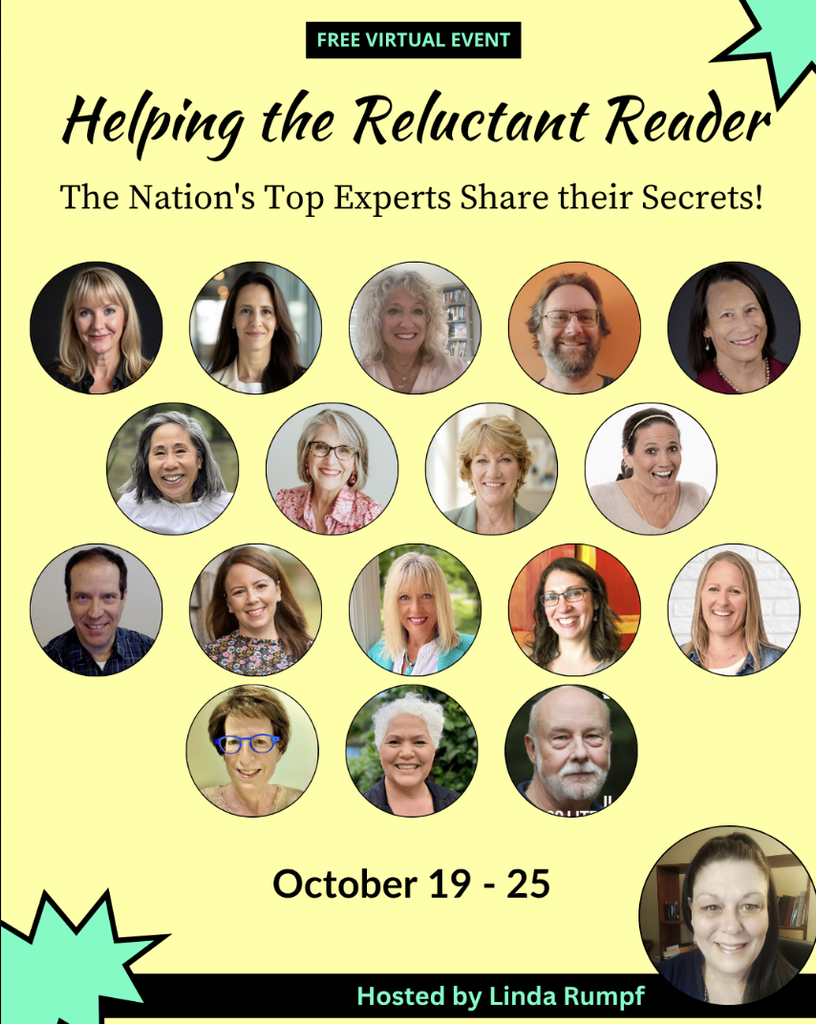
Do you have an anxious or reluctant reader on your hands? If so, keep reading..

Since October is Dyslexia Awareness Month, I want to introduce you to an innovative shining star in the educational community.
Image by Pexels on Pixabay
Meet Linda Rumpf and her Annual Close the Reading Gap Summit
Linda is the brains behind the 3rd annual Close the Reading Gap Summit, now open for registration and airing to the public on October 19.The Summit is FREE TO ALL, and features some of the top leaders in the field of literacy.
Linda recruited me to participate in the summit and I graciously accepted her invitation to speak with her about students who find reading so painful they become anxious, reluctant, and even refuse to read aloud either in public or when working with a teacher or parent. I am honored to be one of many speakers who volunteered time to speak with Linda, hoping to help others more easily achieve the gift of literacy.
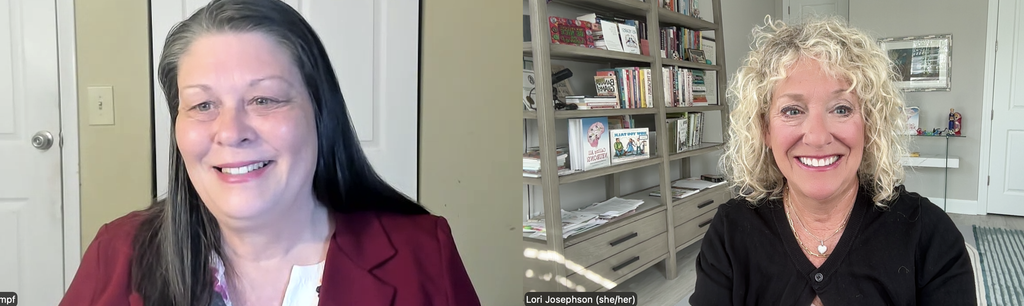
Linda and me! Screenshot by Lori Josephson
What are the topics and who is speaking?
I have to say again that I feel honored to be standing alongside great literacy experts! I will be talking with Linda about my book, Calling All Neurons! How Reading and Spelling Happen, which can help the reluctant reader become more motivated and successful.
The best part: Let me repeat that participation in the Summit is FREE!
Click here for your FREE ticket.
So as not to bombard participants with too much information at once, Linda organizes her summits so that the speaker talks are spread out over a week’s time with a few dropping down right into viewers’ email inboxes each day. Participants are able to purchase the recordings if desired, enabling the conversations to be viewed at one’s convenience and revisited in the future.
I can’t wait to attend!
The Summit runs from October 19-25, 2026. View the breakdown by topic and speaker below. ⬇️
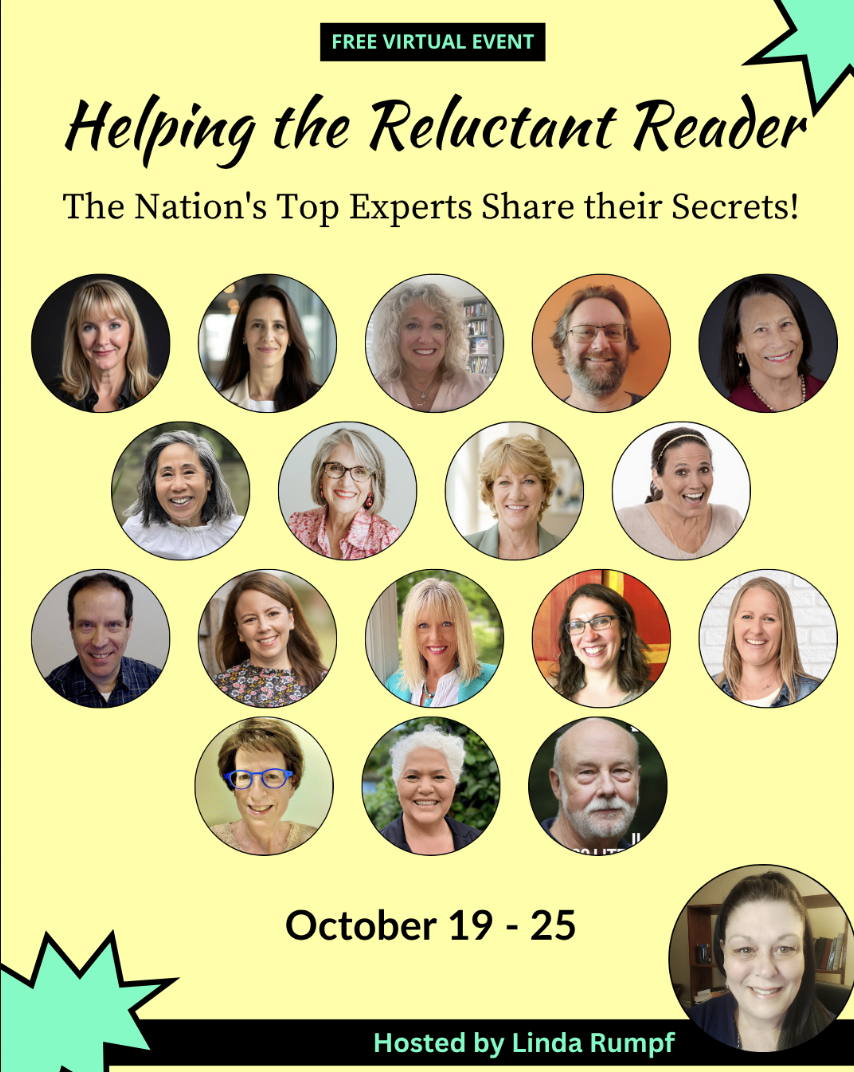
Day One: Working With Reluctant Readers
Dr. Louisa Moats, Nora Chahbazi, Dr. Marnie Ginsberg, and Emily Gibbons
Day Two: Turning Reluctant Writers into Brave Writers.
Julie Bogart
Day Three: Understanding the psychology of reading refusal: keeping things bite-sized, scaffolding, and flipping the script
Dr. Melanie Wilson, Melanie Jeffrey, and Sarah Collins, MSOT, OTR/L
Day Four: Teaching so They Can’t Fail
Kurt Engelmann, Sherrie Rain
Day Five: Fun with Words: Generating Interest in Reading with Morphology and Poetry
Dr. Pete Bowers and Dr. Tim Rasinski
Day Six: Enticing Books: Your Secret Weapon
Mia Wenjen, Joanne Kaminski, and Lori Josephson
Day Seven: Games and Music!
Emily Laidlaw, Kim Yarson
More About Linda
Linda began her career training as a Waldorf teacher in California with Rudolph Steiner himself. She is well-versed in utilizing various child-centered, multi-sensory techniques, as they are part and parcel of the Waldorf philosophy.
After raising her children, Linda felt ready to return to her vocational passion via remote tutoring. Because of the Covid-19 pandemic and its aftermath, demand for Linda’s services exploded. Not only does Linda tutor individual students of all ages, but she also:
- single-handedly puts together her Close the Reading Gap Summit.
- is in the midst of completing her Master’s Degree in Reading Science at Mt. Saint Joseph University
- supports families/caregivers to help provide them with the knowledge and tools needed to support their children, homeschooled or not.
Having interviewed Linda for this piece, I can tell you she is insatiably motivated, as she puts it, “to change the culture of our country” and put real knowledge about reading intervention in the hands of parents so they can help struggling readers at home. She believes activating parents on a wide scale could help expedite the raising of literacy rates in the U. S.
My Take
That said, I am personally gratified to know about and participate in the improvements in literacy instruction over the past few years so that they are more aligned with the tenets of the Science of Reading (SOR).
Who do we have to thank in addition to individuals (like Linda and me!)?
- Efforts of organizations such as The Reading League, The International Dyslexia Association, Parents for Reading Justice
- Efforts of educators and parents/caregivers resulting in passage of SOR legislation in now 49 states (all but Hawaii)
- Emily Hanford and Christopher Peak, creators of the wildly popular APM Sold A Story Podcast. Click here to listen to Season 1 summary; Season 2 is due to drop next week! Hanford truly brought SOR to the public’s attention.
- Facebook Groups such as Science of Reading-What I Should Have Learned in College, led by Donna Hejtmanek. The group now boasts over 244,000 members, with individual state, grade level, and parent offshoots. I have been one of the moderators of this group for the past 5 years. Trust me when I tell you I’ve learned just as much as I’ve shared my knowledge with educators and parents.
- The many colleges of education are now shifting the focus of their pre-service teacher education so that today’s teachers are well-versed in SOR so that they can more optimally meet the needs of today’s students. Although we have the knowledge base, more work is warranted in terms of implementation and increasing the number of colleges teaching teachers methods aligned with SOR research and programs. It is a work in progress.
- Finally, the efforts of pinnacle researchers and practitioners, including Drs. Louisa Moats, Maryanne Wolf, Stanislaus Dehaene, Nadine Gaab, Mark Seidenberg, Daniel Willingham, Linnea Ehri, Anita Archer—these are just a few of the standouts in the field.
She Started with an Idea: “Parents Are The Boots On The Ground.”
Many past participants in Linda’s Close The Reading Gap Summit asked this question of the speakers:
“Can I homeschool a dyslexic child?”
According to Linda, the expert speakers’ responses were a resounding “YES!”
Again, according to Linda, parents/caregivers have far more time to spend with their children than a classroom teacher with a room full of students or a tutor who sees a child twice weekly for an hour.
Although Linda cannot mandate or police the parents/caregivers of her students, she encourages them to have their child read aloud for 30 minutes per day, particularly on days when not attending tutoring sessions.
Linda firmly believes that this one act alone will improve most students’ ability to read with fluency (the ability to read accurately, at an appropriate speed, and with proper expression). I want to add that fluent reading also includes students’ ability to appropriately comprehend the text read. Students who read accurately and quickly without comprehension skills are often referred to as ‘word callers’. A ‘word caller’ who does not use proper expression or comprehend the text is not a student who is reading for meaning, but who may look as if he/she/they are able to read.
Linda has witnessed immense improvement in terms of her students’ reading fluency with the families who follow her directive to read aloud 30 minutes per day. She told me of a dedicated parent who did not read English (or even speak English very well), but made sure her son read English aloud to her 30 minutes daily while she tended to her other children and household tasks while in the same room. Her son had been two years behind in reading when Linda began his tutoring lessons. The dedication of the parent paid off. The student gained a grade level in reading fluency after only six weeks. This experience inspired Linda to start the Close the Reading Gap Summit two years ago to encourage parent participation in their children’s reading remediation.
Linda told me of a homeschooled child who simply needed more processing time than her parent had been used to providing. Linda stated, “This mom was a wonderful homeschool teacher; she homeschooled 6 children and just had to get the job done.” When Linda listened to/watched this very dedicated and caring mom/teacher feeding unknown words to her daughter quickly, she also noted the grumpy expression on this little girl’s face. Linda suggested that simply “tweaking her lessons” to allow for more processing time and perhaps using strategies together to figure out those unknown words would be beneficial to her child. In fact, these “tweaks” did the trick! The child began to relax when given the time she needed to come up with the answers herself.
Many students with dyslexia require an intense structured literacy approach such as Orton-Gillingham (OG). According to Linda, “OG is a slow go, but it needs to be.” The ‘slow go’ is often due to difficulties with a student’s working memory. Structured literacy involves teaching students not only how to decode (read), but also to encode (spell) and write (handwriting, grammar, syntax [correct word order]). Every student is a bit different, and Linda adjusts her approach according to each student’s needs.
Many teachers and families/caregivers need to be more cognizant of the large amount of repetition (and therefore time) some students need in order to crack the code that is our rich English language for reading, spelling, and written language. Linda is well versed in OG techniques, as she has studied it and completed her OG practicum as part of her Master’s Degree.
What comes to my mind is OG matriarch Anna Gillingham’s famous quote. She routinely said, “Go as fast as you can, but as slow as you must,” referring to the pace of instruction for struggling students.
Linda’s Passion
Linda’s greatest passion is to help parents be better able to teach and support their children on their literacy journeys.
As I mentioned, many of the parents Linda works with are those who homeschool their children. Linda asserts that while the majority of homeschool parents have no difficulty teaching the actual content of reading lessons, making “little fixes can be very profound.”
Who can fault a student who is a reluctant reader? After all, Linda states, “Nobody wants to do something they aren’t good at.” Obviously, I share Linda’s strong desire to improve the literacy skills of struggling students. Kudos to Linda for all the good work she does to make the world a better place.
I hope you tune in to Linda’s Close the Reading Gap Summit! It’s a great way to celebrate Dyslexia Awareness Month. Please share this article with others who may be interested and share your thoughts with me.
With all this serious talk about reluctant readers, don’t forget to enjoy your children as you get ready to celebrate the fun and excitement that is Halloween! BOO!
Let me know what you think about the Close the Reading Gap Summit!

Image by new friend from Pixabay
Not one word of this article was written using AI.