
It’s summer and the livin’ is easy! Or is it?
Many kids find days without ‘something to do’ well, ‘boring’. It is a common tale of woe from the mouths of kids: “I’m bored!”
And many parents literally panic when they know their kids don’t have any scheduled activities and/or play dates with friends.
What can we do to quell the noise for both kids and families?
Image by Mikhal Nilov on Pexels
My Own Experience and a Nice Solution
I spent many years–no, decades–working in a day camp as a counselor and/or administrator, parenting, and providing individual tutoring to kids of all ages. Both my parenting duties and my student caseload were, at times, daunting–I won’t lie.
Oftentimes, I actually tutored many of my students outdoors during the summer months. My home office included a ‘covered gazebo’ with a fan. My students actually loved working out of doors as a change of pace–especially given the climate of northeast Ohio where we lived. Alas, their parents/caregivers regularly arrived on the late side, and I had to begin working with another student. Here is what I said when they wondered what they should do while awaiting their chauffeur: “Go lie down on the grass and look at the trees, the sun, and the clouds.” I then added, “And don’t think about anything, just let your mind wander.” After reading a bit about ‘boredom’ AKA ‘unscheduled down time’, I should have added, “And just let your mind rest.”
“Go lie down on the grass and look at the trees, the sun, and the clouds. And don’t think about anything, just let your mind wander. And just let your mind rest.“
~Lori Josephson

Depending on where you live, both the trees and the clouds differ—one needs to ‘make do’ with what one has. I now live in Florida, where the foliage isn’t as interesting, nor is it as breezy as it is elsewhere. That said, the clouds are far more interesting. They are the type of clouds which I believe (I have no way to prove my theory) likely inspired the paintings of Raffaello Sanzio da Urbino—known simply as Raphael to most, whose life spanned the 15th and 16th centuries.
Image in the public domain—part of Sistine Madonna
I think about this correlation each and every time I gaze up at the clouds. I must confess I do my best gazing either as a passenger and driver in the car (at traffic lights!). Just take a look–what do you see? What might you be thinking about, especially if you are not reading this article? I took this photo right in my neighborhood about 3 weeks ago. I could share what I see, but what would be the point? Use your imagination!

Photo by Lori Josephson
I’ll share some videos and photos of the trees…just keep reading!
What is ‘Boredom’? Is it the Correct Descriptor?
I recently listened to the perspective of James Danckert, Ph.D., guest on the podcast Children and Screens. First, Dr. Danckert noted Leo Tolstoy’s definition of boredom: “the desire for desires”. He went on to say that boredom is often viewed as an outlet for creativity. Dr. Danckert issued a ‘hard no’ to the correlation between boredom and creativity.
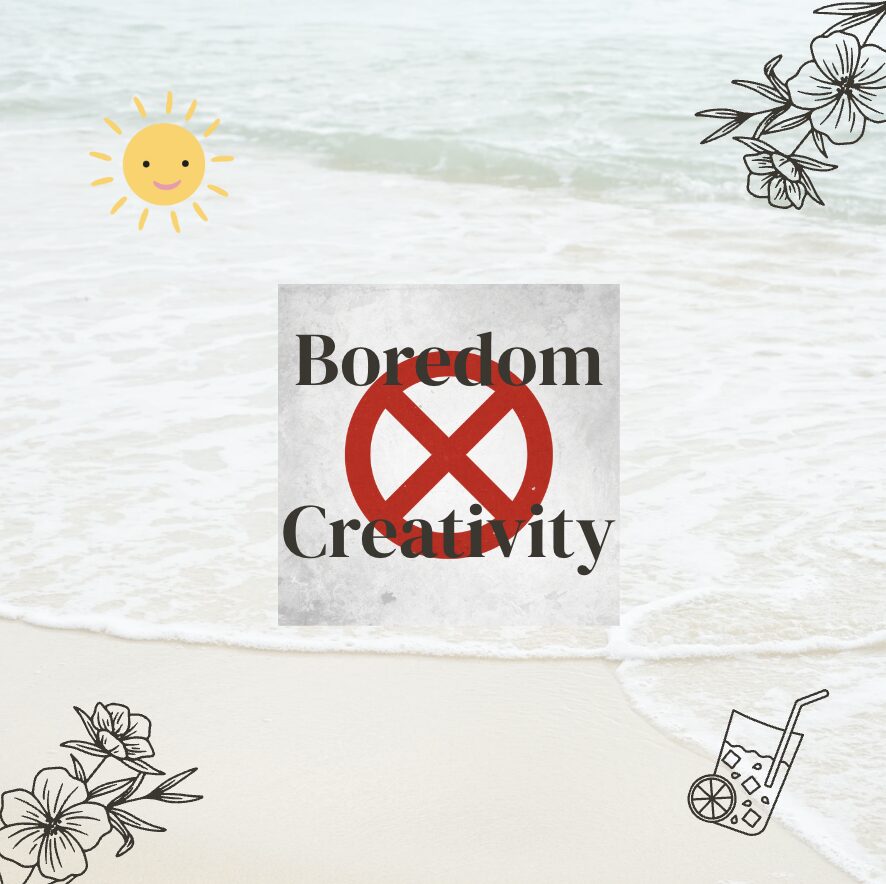
Instead, he describes boredom as “a restless and agitated state.” The person who is bored desires engagement with the world, doing meaningful and purposeful things, but the opportunity at the time does not present itself. In other words, a person who is bored “wants something that he/she/they cannot get.” In fact, states Danckert, the misconception that boredom can be equated with laziness is the worst misconception of all simply because the person in question actually desires something meaningful to do. It is that internal struggle, if you will, which may allow for learning or creativity to take place, but…that is certainly not a given. Being ‘bored’ does not = ‘creativity’.
Image by Lori Josephson using Canva
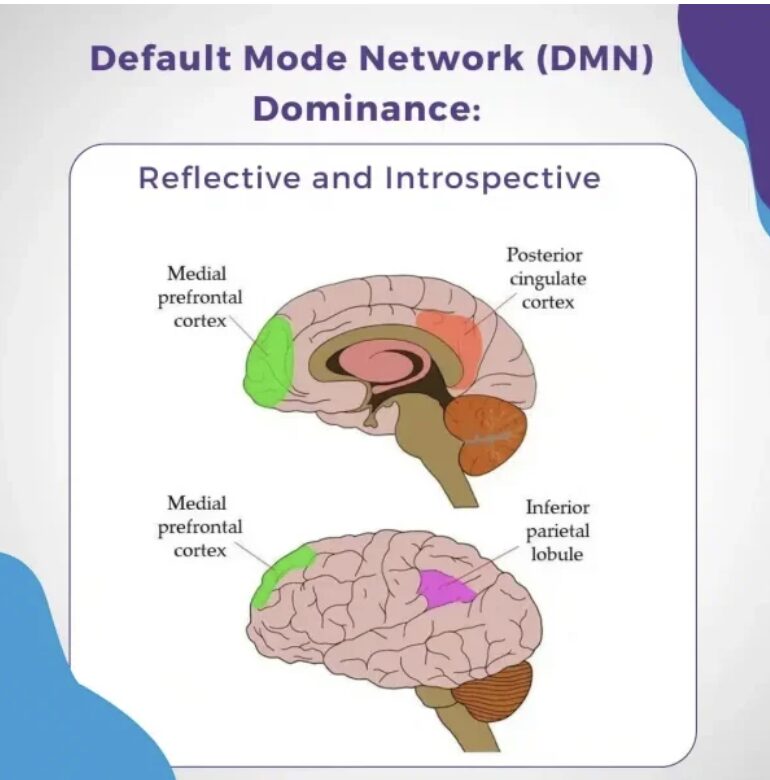
Dr. Danckert went on to describe a ‘default mode network’ in our brains, which activates when a person has no task at hand. When activated, a person can think prospectively about future tasks, or engage in memories even nostalgically. When this ‘default mode’ comes into play, the person (child or adult) must be in charge in how to eliminate it if “bored” rather than someone else providing any type of stimulus.
Default mode network involves the networking of several areas of the brain.
Screenshot by Lori Josephson
Harvard Professor Arthur Brooks views boredom in a similar way, even stating that “boredom is good for people.” Dr. Brooks points out that people “don’t like boredom because it makes them feel uncomfortable”, allowing them self-reflection time to ask bigger life questions. He ultimately feels this self-reflection time is a net positive. Dr. Brooks further points out that technological advances (screen time) have allowed the vast majority of us to simply “eliminate boredom”. In turn, eliminating the brain’s ‘default mode network’ has contributed to increases in anxiety, depression, and an overall feeling of ‘hollowness’. Perhaps it is best for us to learn to cope with boredom effectively rather than eliminate it.
Said another way, Texas A&M Professor of Psychology and Brain Science Heather Lench states, “our brains crave stimulation more than comfort.” Thus, humans have the ability to respond to boredom in either positive or negative ways. Dr. Lench further points out that “when you learn to tolerate and respond effectively to boredom, you’re less driven to meaningless distractions like social media doomscrolling and are more focused on what really matters.”
There is a big difference between ‘boredom’ and what could be described as ‘down time’. Dr. Denckart warns against encouraging boredom. Kids need to learn to think their own thoughts. That said, the encouragement of ‘down time’ is a great thing for folks of all ages. It allows for time and space for relaxation, self-regulation, and a bit of what he calls “breathing room.” I see the intersection of Dr. Brooks’, Dr. Denckart’s, and Dr. Lench’s thinking…do you?
SO LET’S GET BACK TO THE CLOUDS AND TREES
How about providing kids with open-ended, distraction-free time to ‘just be’. According to Healthline, it’s good to set a timer for 5 to 10 minutes. Kids (or you!) might feel the urge to go talk with someone, pick up the cell phone, or do something deemed productive. Take a few deep breaths and just ‘be’ in the moment, observing the environment and actually feeling one’s body and one’s feelings.
According to a 2024 study (Izumi Uehara) appearing in Science & Society, “the ability to cope with boredom itself may be related to fruitful living….since the ability to cope with boredom is acquired during childhood, extensive research is needed on the developmental process of an individual’s boredom tendency and boredom-control skills from childhood to adolescence.”
Here are some photos/videos I took when experiencing the ‘Default Mode Network’ over the past few weeks.
Here’s another pic I took of the clouds recently. What do you see?

What do the trees moving in the breeze make you think about? The first video I shot was taken in central OH this past June. Notice the sound of the rustling leaves and the differences in the clouds from above! The second video I shot from the foothills northwest of Denver, where water was running down below in addition to the sounds and sights of the leaves. Both are beautiful and engaging, IMHO!
It’s OK to have your head in the clouds, right? If you comment on what you see and how you feel, I promise I’ll respond!
Enjoy what remains of the summer.
Not one word of this article was written using AI.
What a fantastic post. It is wonderful the way you pull in other “professional voices” into your dialogue.
My favorite takeaway was the line, “Kids need to think their own thoughts.”
As a tangent, I can see the need for kids to do more of their own thinking when I am doing tutoring. Because I require the parent to be present, I witness well-meaning and super supportive parents jumping in too quickly when a child is thinking and using their thinking tools, and may give “the answer” or immediately explain where/how the child erred. The result: the child is not doing the thinking nor becoming the problem solver. (In a light-hearted way, I have asked/hinted to more than one parent not to interject!) Many moons ago, as a Title I reading teacher, I was going into a classroom and teaching phonics. At the end of the year, the brand new teacher said, “Mr. Verhoff, I notice that when the kids don’t have the answer or respond quickly, you wait a bit. The new teacher said she just assumes the children know the answer and says it for/to them. This scenario spoke volumes to me.
THANK YOU again for a great, informative, and thought-provoking read.
Thank you, Glen!
It is always nice to hear from you!
I truly love your takeaway line, as I personally really didn’t give it much thought!
Glad to hear you are still at it in terms of working with kids–and I find your observations thought provoking and interesting as well! We are both fortunate to have careers where we really can make an impact!
Best,
Lori