
Do you know who penned this quote?
Do you know why this person stated these words?
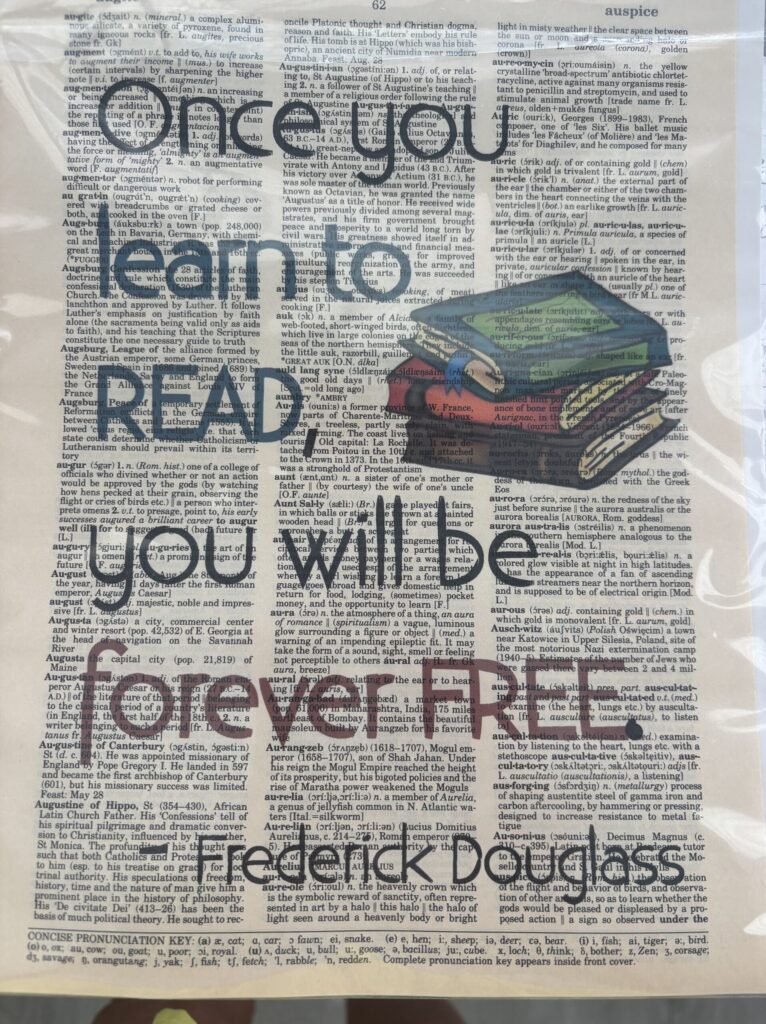
I was given a copy of this illustration as a ‘thank you’ for presenting a webinar a couple of years ago. I didn’t truly understand the person behind the quote until recently. I happened to listen to this person’s biographer, Professor David Blight, featured on On Point, an always interesting show on NPR. I have been thinking about it all month.
Screenshot by Lori Josephson
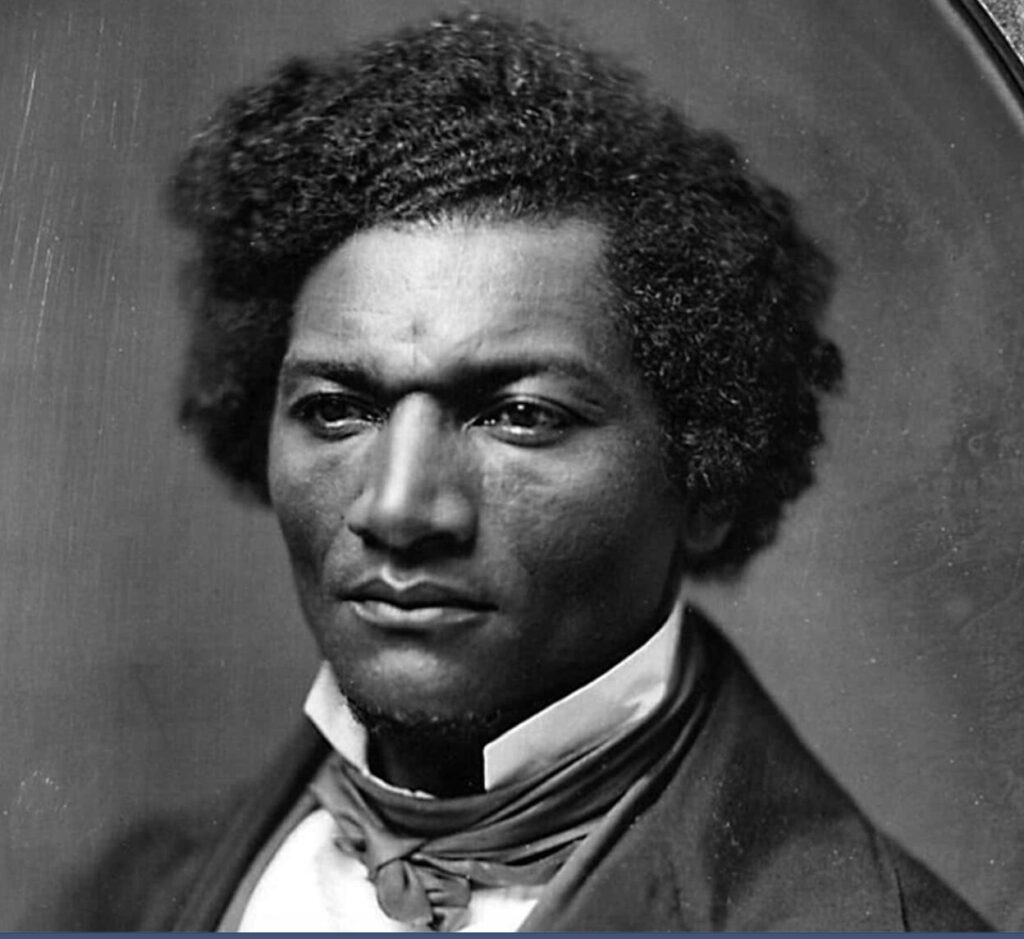
Let me share the story of none other than Frederick Douglass, a runaway slave turned orator and abolitionist. And let me give you something to think about as we approach our nation’s 250th anniversary.
Here is the Story
Frederick Douglass was born sometime in 1818, passing away at the age of about 77 in 1895. Yes, he lived a long life for that time. Born a slave, Douglass spent 11 of his slavery years on a plantation on Maryland’s Eastern Shore. He lived in Baltimore for 9 years, where he was considered a ‘city slave’. He escaped in 1838, around the age of 20.
While a ‘city slave,’ his mistress, Sophia Auld, taught tween Frederick his ABCs, and simple three-letter words to read and spell using the Bible. When Douglass’ Master, Hugh Auld discovered his wife’s activities, he forbade her from continuing to teach young Frederick. Douglass himself states in one of his three autobiographies that it took him about 7 years to learn to read and write. Over time, Douglass stated, “Nothing seemed to make her more angry than to see me with a newspaper.” Douglass notes that despite having little experience, Sophia Auld arrived at the realization that education and slavery were incompatible. Mistress Auld apparently routinely snatched written material she saw in Douglass’ hands.
Given this predicament, how was it that Frederick Douglass eventually became literate? Douglass’ account: “Mistress, in teaching me the alphabet, had given me the inch, and no precaution could prevent me from taking the ell.” An ‘ell’ is an obsolete unit of measure, just over a yard. This idiom has been replaced by “given an inch he will take a mile.” It literally means to take advantage of a small concession to obtain a whole lot more.
You see, Douglass created his own literacy plan.
Since he had access to food (he mentioned ‘bread’), he arrived on Philpot Street in Baltimore with bread (and a book) in hand when sent on errands. He amassed as many teachers as he could in exchange for reading lessons from the “poor white boys” on the streets. In Douglass’ own words, he stated he received the “far more valuable bread of knowledge.”
Frederick began to think about his escape, but believing himself to be too young, he set in motion a plan to also learn to write. He began to formulate a plan that would allow him to “write my own pass [to freedom].” He learned to write at the shipyard, identifying the names of various letters, and copying them on pieces of timber.
Here is the plan in Douglass’ own words: “When I met with any boy who I knew could write, I would tell him I could write as well as he. The boy would respond, “I don’t believe you. Let me see you try it.” I would then make the letters which I had been so fortunate as to learn, and ask him to beat that. In this way I got a good many lessons in writing, which it is quite possible I should never have gotten in any other way.”
Pretty clever…
Young Douglass practiced using whatever he could find including chalk, bricks, pavement—anything he could find to practice. In time, the son of his Master Hugh Auld, Thomas Auld, began school himself. Thomas had several ‘copy-books’. When Mistress Sophie Auld left the house in Frederick’s care, Frederick spent the time practicing his writing using the copy-books Thomas had ‘set aside’. Douglass describes this process as “long and tedious”, stating he learned to write after “several years.”
Not only did Frederick attain literacy, but he began teaching other slaves when sent back to the Maryland Eastern Shore plantation in 1834. Despite severe beatings at the plantation, Douglass held secret Sunday Sabbath and evening classes for about 40 slaves from his and neighboring plantations.
His eventual escape plan involved a disguise/intricate plan as a ‘free Black sailor’ who boarded a northbound train from Baltimore in 1838.
You see, Frederick was sent back to Baltimore to work in the shipyards, with a promise of eventual freedom at the age of 25. In the end, Frederick did not wait for that promise to play out. Douglass settled in Massachusetts, becoming a famous writer, orator, and abolitionist spokesman. I offer you the opportunity to read more about Frederick Douglass here.
I wish to discuss one of his more famous and salient speeches, especially this week as we celebrate the nation’s 250th anniversary—fanfare and all.
The July 4th Speech Delivered in 1852
Frederick Douglass delivered what is perhaps his most famous anti-slavery speech to 600 members of the Ladies Anti-Slavery Society in Rochester, NY on July 5, 1852.
Screenshot by Lori Josephson
He asked his audience a simple question: “What, to the American slave, is your 4th of July?”
And Douglass uses his gift of oratory to continue to separate himself (and too the American slaves) from his audience of free folks repeatedly using the pronouns ‘you’, ‘your’, and ‘yours’ to make his points.
His major point, of course, is the notion that the 1776 Declaration of Independence proclaimed that all men are created equal, freedom for all, etc. Douglass likened July 4 to the day of your deliverance and “birthday of your national life.” The irony, of course, is the obvious comparison of the grievances of the Founding Fathers with the grievances of the enslaved people of America, which still held true in 1852.
NPR’s On Point featured some of Douglass’ words spoken by his descendants. Here is but one that hit home for me:
“What to the American slave is your Fourth of July? I answer, a day that reveals to him more than all other days in the year, the gross injustice and cruelty to which he is the constant victim.
Fraud.
Deception.
Impiety.
And hypocrisy. There is not a nation on the Earth guilty of practices more shocking and bloody than are the people of these United States at this very hour.“
These are powerful words.
Dr. Blight went on to say, in Douglass’ opinion, the Declaration of Independence went into far more detail in terms of the right to revolution if certain demands were not met than it did to discuss the basic rights of human beings including life, liberty, and the doctrine of consent.
Let’s get back to how this connects to attainment of literacy.
Ideas to Think About on July 4, 2026
I loved sharing the story of Frederick Douglass’ literacy journey with you, my readers. To me, this journey exemplifies the ultimate test of resiliency. Of course, Douglass is an exceptional person who achieved many, if not all, of his goals–and did so against all odds. Douglass’ ability to read and write undoubtedly led to his freedom and ability to help others to think and also be free.
And of course, Douglass’ achievements didn’t ‘make things right’ for the vast majority of his people.
If a person cannot read, is that person truly free?
Today, far too many students (and even adults) STILL have difficulty attaining literacy. Why is it that our system of public education is still not optimally effective in teaching literacy?
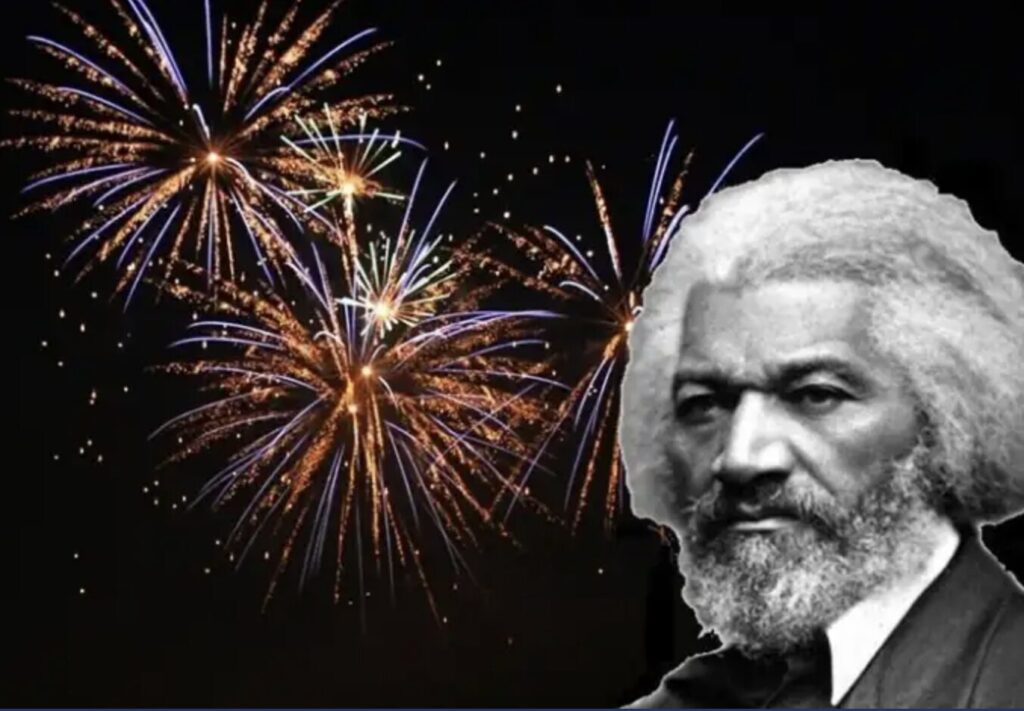
Frederick Douglass’ words ring true to me today, while the country is celebrating the 250th Anniversary of its birth:
“The 4th of July is yours, not mine. You may rejoice, I must mourn.”
Screenshot by Lori Josephson
I repeat the 1852 words of Douglass again: “What to the slave is the 4th of July?”
What to the non/struggling reader is school?
To me, it is no surprise that so many of our students:
- dislike school and even state they dislike reading
- have difficulty becoming proficient readers and writers
- continue to feel the shame and anxiety that comes with the struggle to manage print
- end up in our penal system (over 70% of incarcerated adults are functionally illiterate; an estimated 85% of youth appearing before the court system struggle with basic literacy)
Frederick Douglass said, “oppression makes a wise man mad.” To me, this epitomizes the concept of ‘reading trauma’, a term which is commonly used these days to describe struggling students, dyslexic or not. It is maddening.
It is no wonder our nation’s overall reading and writing (not to mention math) achievement continues to be in need of improvement, despite what we know about how the brain attains literacy. It is no wonder that families and advocates continue the struggle to work within an educational system designed to teach all students the basic right of learning to read. Although things are improving for many, we need to work smarter (not harder) to better prepare pre-service teachers and translate research into practice/universal implementation across the board.
Your comments are most welcome.
Not one word of this article was written using AI.
Beautifully written my talented friend and teacher.
Stephanie,
Thank you so much for your kindest of words!!
LJ
Thank you for posting this. With the 250th anniversary, people are already thinking about freedom in a different way, and your post gave me another perspective I hadn’t thought about before. It definitely made me stop and reflect on what “being forever free” really means for someone who struggles to read. I think that’s a message that’s always worth talking about.
I appreciated you sharing Frederick Douglass’s story. His journey to literacy was new to me, and it really is the perfect example of “where there’s a will, there’s a way.”
At the same time, it also made me think about those whose experiences with reading were very different. I have relatives who struggled with reading. They learned ways to compensate, but they also learned to hide their struggles. Your line, “continue to feel the shame and anxiety that comes with the struggle to manage print,” really hit me. It reinforced for me that while they may eventually find ways to function, they never really experience the freedom Frederick Douglass was talking about—not while they’re carrying that fear of being “found out.”
Your post really made me stop and think. It also made me hope that these kids don’t just learn to read—they someday experience the excitement and freedom of opening a book with anticipation instead of self-consciousness and dread. To me, that’s what “forever free” really means.
Tracey,
Thank you so much for your insightful comments!!