
I have a lot to say about Liana Loewus’ recent article, “The Cost of Over-Teaching Phonics”, which appeared in Education Next this month. The article sparked a good deal of conversation amongst stakeholders in the literacy community on various forums including Substack, Facebook, and LinkedIn. I posted the article. It received no less than 90+ reactions and 120+ comments as of this writing (most on the FB page Science of Reading-What I Should Have Learned in College–I have been a Moderator for nearly 5 years now!). All reactions were a ‘thumbs up’. Many of the comments mirrored my thoughts. I always welcome a hearty discussion with feedback, no matter neutral, positive, or negative.
On April 15, Kata Solow and Science of Reading Classroom published a piece on Substack entitled, “11 Thoughts on the Over-Teaching Conversation”. I’d like to add to and expand a bit on this piece as well.
I am an educator/consultant turned author with decades of experience actually in the classroom both as a practitioner and coach. I have taught literally 100s of students who had difficulty attaining literacy. Most had a diagnosis of dyslexia. I have facilitated professional development courses–too many to count. I’ve literally worked with 1000s of teachers/administrators explaining how literacy is attained whether the students are struggling or not. I have also guided scads of families/caregivers in their quest to help their young ones. Thus, I suggest that my voice lends credence to current teachers, administrators, curriculum publishers, families/caregivers—and concerned citizens. Although I provided the same information to these folks, implementation and support varied considerably.
Where to begin? The ‘big’ we (researchers, educators) know a lot, but we don’t know it all. A good deal of variation exists in terms of knowledge base. More importantly, variation exists in terms of implementation at both the curricular, pre-service teacher preparation, professional development, and practitioner levels. Additionally, the attainment of literacy involves more than simply reading (decoding). Literacy also includes spelling (encoding), and written language. (sentence structure, syntax, grammar, punctuation, handwriting, keyboarding).
Let’s begin with the comments of literacy leader Mitchell Brookins, Ph.D. His response to claims that phonics is being ‘over taught’ is three pronged: SCALABILITY, EFFICIENCY, and the possible CONSEQUENCES of powerful words. These comments stand independently. I couldn’t agree more with Dr. Brookins’ stance.
“The overt-arching argument is focused on the minor rather than the MAJOR things we need to do. We know over-teaching is occurring in terms of the teaching of blends, syllabication skills, and use of sound walls–these are the minor issues. We need more educators providing high quality evidenced-based instruction–this is the MAJOR issue.”
“We need to ensure our instruction is efficient and can accelerate our children’s literacy growth.”
“The over-teaching narrative in U.S. public schools is not the message that should be heard. How can something be over-taught when this many children are failing? Saying we are over-teaching can cause unintended consequences.”
Mitchell Brookins (2026)
My recent conversation with Susan Connick, Solutions Facilitator at Hynes Charter School in New Orleans and Teacher Leader Advisor for the Department of Education in Louisiana made a lot of sense. I echo her concerns regarding curriculum pacing maps. Ms. Connick asserts, “Pacing maps can be problematic in schools when teachers are not given the time and space to provide targeted instruction to meet the needs of their students. The conversation should not center around eliminating phonics instruction by a certain age. Instead, it should focus on ensuring that students receive the phonics instruction they need, for as long as they need it, to become proficient readers.”
Thus, students who could be spending time reading authentic text and writing about what they are reading sit through phonics lessons. Simultaneously, students who need to circle back with more practice with concepts not yet mastered sit through phonics lessons far beyond their reach. Talk about the antithesis of teaching efficiently.
The Research and Researchers
Researchers have provided vast amounts of truly valuable information about the attainment of literacy. As much as I admire and adhere to many of their findings, and as knowledgeable as these folks are, many have not taught in a K-12 classroom. According to Loewus, “research on phonics mostly supports broad principles rather than detailed step-by-step instructions or guidance on specific skills. This creates challenges for curriculum developers and teachers seeking concrete guidance.”
So, to say that students should be taught enough phonics so that a “light bulb” goes on enabling students to employ “self-teaching mechanisms” seems a stretch, particularly without empirical evidence. In fact, if this were the case, far more of our students would have proficient literacy skills. Both Loewus and myself are concerned that despite increased teaching of phonics, many students remain behind due to mixed messages and inconsistent quality of instruction.
I do appreciate the words of Special Education Professor Nathan Clemens. He states, ““How much phonics instruction they should be taught per day, when should it stop, across how many grade levels—we don’t have evidence to point to that. And we probably never will, because there’s going to be so many individual factors that will play into it.” Absolutely!
As Kata Solow states, “We don’t know how many places are over-doing and under-doing phonics instruction.” Although schools across our country continue to use Heggerty to work on oral phonemic awareness, recent research indicates no correlation to improved literacy skills. Clearly, instructional time spent could be better spent.
The jury is out. More research is needed on a much larger scale assessing the implementation of evidence based instruction aligned with The Science of Reading, which encompasses far more than phonics.
The “Rules”…and What About Teaching Struggling Readers?
I am a rule follower—I like rules.
The English language, alas, does not adhere to hard and fast ‘rules’. I prefer to use the term ‘pattern’ because ‘patterns’ are more flexible. The term ‘pattern’ is better suited when explaining how reading and spelling work.
Suffice it to say the ‘rules’ discussed in Loewus’ article are ‘small potatoes’ in comparison to the big picture regarding research and implementation needs.
Just for clarification, the ‘rules’ noted may be the most well known, but are actually misleading.
- FLOSS Rule was discussed, noting exceptions ‘bus’ and ‘gas’…both are shortened forms of the words ‘autobus’ and ‘gasoline’, hence the absence of doubling the final consonant ‘s’ in both examples. FLOSS is better taught as a pattern more useful for spelling than for reading.
- “I before e” chant was discussed. I want to note that this ‘rule’ is often untrue and is “built on a foundation of lies.”
One more misleading ‘rule’ often taught is: “when 2 vowels go walking the first one does the talking.” So in a word such as ‘brain’, the ‘ai’ will represent /ā/. This ‘rule’ is true a mere 43% of the time when analyzing the most common 1000 words. Nonetheless, a quick Google search reveals numerous jingles, posters, and videos used to ‘teach’ this misleading ‘rule’.
The notion that knowledge of certain ‘rules’ provides too much of a cognitive load for already struggling students simply does not hold water for me as a practitioner. It is not necessary for students to memorize these patterns. Students simply need to be aware of the pattern and apply the pattern without necessarily parroting the ‘rule’ verbatim.
I am all in on ‘set for variability’ in terms of students who need to adjust the pronunciation of vowels when decoding, but…
These students benefit from being directly taught sound/symbol associations for both short and long vowel phonemes signified by one grapheme (letter). In other words, the ability to identify just 2 of the 6 syllable patterns (Closed and Open Syllable Patterns) can make a world of difference for ‘readers-in-training” to the tune of decoding 75% of all syllables in more than 17,000 words. Furthermore, Closed Syllables (predictably short vowel pronunciations in 95% of words) alone account for 43% of English syllables (Stanback 1992).
The practical truth is this: Knowledge of the Closed and Open syllable patterns more often than not determine the vowel sound (short or long). Using this knowledge is a far better strategy than guessing or using context. Teaching just these 2 syllable patterns is an efficient pathway for most ‘readers-in-training’ . Must students be able to ‘mark’ the vowel sounds either short (using a breve: ◌̆) or long (using a macron: ō)? Not necessarily, but it does help teachers to assess if a student understands the concepts and provides a tool to help students to remember the concepts. Understanding concepts helps students apply them when actually reading and spelling.
Certainly teaching these 2 syllable patterns results in a great deal of ROI (return on ‘teaching’ investment). Ms. Loewus and I concur on the teaching of these specific skills, as they are “essential, high-impact patterns.”
When teaching various patterns, I routinely heard these very same words year after year from struggling students of all ages:
“Why didn’t anyone ever tell me this before?”
Some students felt relieved to be able to finally understand the structure of the English language, while others were angry they weren’t previously told this information. As the UFLI phonics program demonstrates, keeping things organized, simple, and direct is one key to greater success. No frills, no stories, just information taught explicitly.
The idea is to create “order out of chaos” for students. For some teachers, many of the phonics concepts now taught are new information. For sure, it is hard to teach what one does not know. Many teachers are indeed excited to create order for themselves, likely resulting in increased efficiency!
What About the Vital Importance of Morphology?
One item not mentioned at all was the inclusion of morphology (study of the meaning parts of words inclusive of prefixes, suffixes, and base words and word roots). The English language is ‘morphophonemic’, which means that it is both meaning and sound based. In fact, morphology overrules phonology as far as spelling is concerned.
For example, once students are aware of the Greek based root ‘phon’ (meaning ‘sound’ or ‘voice’), which is the basis for words such as: phone, phonograph, homophone, symphony, and well, ‘phonics’!), the students will hopefully be able to realize (or be taught) that all of these words use ‘ph’ to spell /f/ rather than ‘f’.
In fact, a good deal of ‘academic vocabulary’ used in all subjects of school curriculum involve knowledge of Latin and Greek roots, particularly math, science, and social studies (90% !). Teaching the most common roots is teaching efficiently. In fact, over 60% of all English words are derived from Latin and Greek (Jones, 2023). Just this week, high school student Charlie Friedman in The 74 writes: ” Latin is an equity tool, and we don’t acknowledge that enough.” Ms. Friedman echoes the high statistic of academic words derived from Latin, resulting in improved vocabulary, knowledge of grammar, and reading comprehension. Sadly, many schools are phasing out Latin course offerings nationwide. She references a charter school in a low SES area of New York City offering Latin beginning in Grade 3 as ‘flipping’ the equity-elitist notion of exposure to Latin.
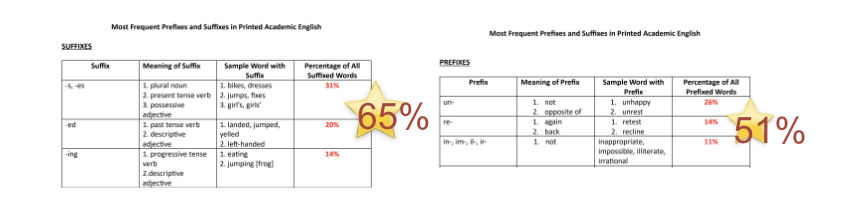
I posit that once students have achieved some basic phonics skills, directly teaching just a few basic suffixes increases students’ comprehension and syntax. For example, even the youngest of readers can understand that the suffix ‘-ed’ signifies something has happened in the past or that suffixes, ‘-s’ or ‘-es’ signify: plural (more than 1) or (present tense) or happening ‘right now’ . See the illustration on the left. The entire list is available here.
I realize I am getting ‘into the weeds’; however, ‘over-teaching phonics’ articles omitted even a mention of morphology.
More Time for Actual Reading? What About Writing? DEFINITELY!
What is there to debate? Of course, allowing time for student to practice actual reading is the goal. And I admit I have witnessed many classrooms where the phonics lessons dwarf actual time spent ‘reading’. The more one reads, the more practice one gets–think about any sport or learning any musical instrument in terms of practice pay off.
I recently wrote a series of articles this past fall and winter discussing the differences between decodable and authentic texts, as well as on the importance of exposing children to ‘book language’ as early as infancy. Read them here and here.
Here’s the short version:
- Children need exposure to ‘book language’ (language, well, found in books)–this is authentic text with robust vocabulary, sentence structure, and descriptive language from the earliest years–especially when in the midst of learning to decode and continuing far after they have ‘cracked the code’.
- Children benefit from decodable text in order to practice and apply taught phonics skills…but for a short window.
Hard as I tried, I could not find research to quantify when the shift from decodable to authentic text should happen. Clearly, research is needed here. Louisa Moats noted that students need to recognize (without the need to ‘sound out’ or decode a modicum of words, many of which will be high frequency and often non-phonetic words). View the video here. Linda Farrell suggests knowledge of short vowels, digraphs (such as ‘ch’), consecutive consonants (note the avoidance of using the term ‘blends’–and I wholeheartedly agree! No need to teach any of this.), ability to read words with ‘schwa’, some ability to read multi-syllable words with several syllable patterns, and ability to recognize about 90 high-frequency non-phonetic words such as ‘of’.
Struggling “readers-in-training’ ought not to be asked to sit at their desks and read independently, nor read aloud until deemed ready. These practices also constitute a waste of instructional time, not to mention the detriment to student self-esteem. These students require more intensivity of instruction. Both Loewus and I agree that although challenging, we must strive to balance whole group, core instruction with additional supports for students with dyslexia and other learning needs.
An item not mentioned is the use of digital text in lieu of actual hard copy books. According to Dr. Maryanne Wolf, printed books are especially important during the foundational years as students are learning to ‘crack the code’. Additionally, she recommends using printed books as essential for deep reading, which lends itself to better comprehension and the development of empathy [in narrative text]. Digital text encourages skimming, which is limiting, and limits spatial and kinesthetic memory print books provide.
Two final points. 1-Students write about what they read since it enhances learning and allows for written language practice. 2-Exposure to complex text which ‘stretches’ readers results in better outcomes. Read about it here
Call to Action
We all need to take a step back and look at the big picture. Our children’s lives and society at large depend on it. And…wouldn’t it be great if we could lighten the load of teachers? Clearly, Loewus and I agree upon “the existing gaps between legislation, accountability, and actual classroom practice.” As Dr. Brookins points out, we have 3 needs:
- More time for more implementation research in a SCALABLE way
- Methods to ensure teachers are teaching most EFFICIENTLY
- Ways to send messages to all stakeholders which AVOIDS CONFUSION about what we know about how the brain attains literacy
Perhaps this Aristotle quote says it well. Look at the big picture–don’t get stuck in the weeds.
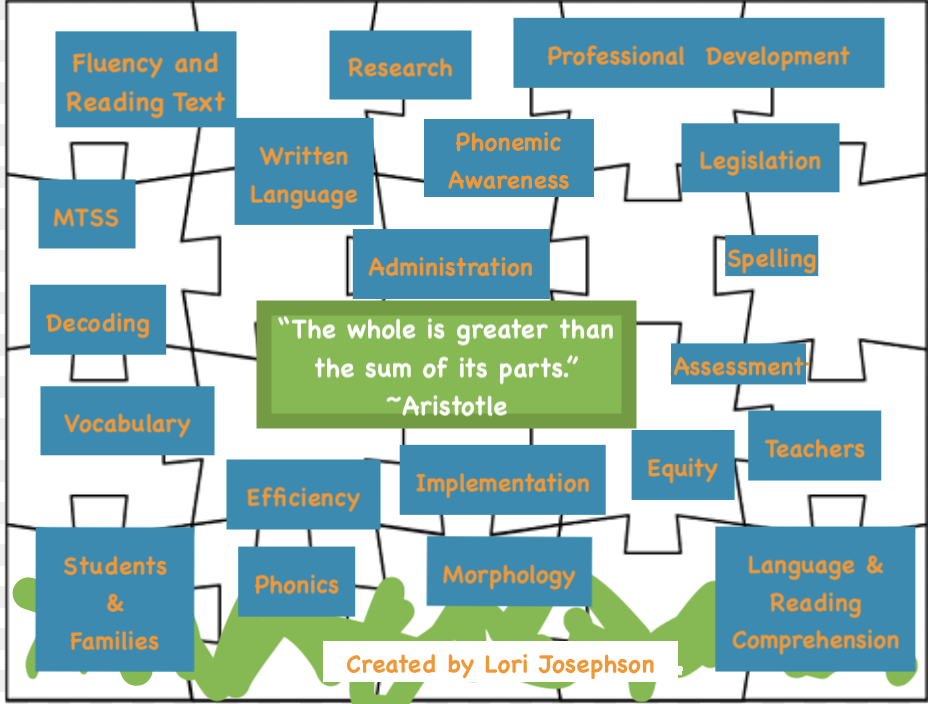
“The whole is greater than the sum of its parts.” Aristotle
Perhaps the words of a parent of a high achieving student say it best.
“High achieving children come to school knowing how to drive the car; this [phonics] program teaches them how the engine works.”
After 40+ years of working with struggling readers, and knowing what we know about how nearly all brains learn to read, I hope all stakeholders realize that literacy involves far more than phonics. What needs to be known for both decoding and encoding can NOT be taught as early as by the close of the first couple of years of formal education. It takes years to become a proficient reader (and writer). As Loewus points out, “we need ongoing nuanced conversations to improve the quality of literacy instruction. Legislation alone does not ensure quality implementation without proper support and oversight.” Let’s avoid confusing messaging and work together to offer optimal opportunity to our students.
Many thanks to Mitchell Brookins, Susan Connick, and Liana Loewus for thoughtful conversations and contributions.
Not one word of this article was written usiing AI.
As always, great info to ponder to improve one’s teaching and student performance/success. Thank you, Lori.
Glen,
How nice to hear from you!! glad you are continuing to get something out of what I put out there….You are most welcome!!
Cheers, Lori